
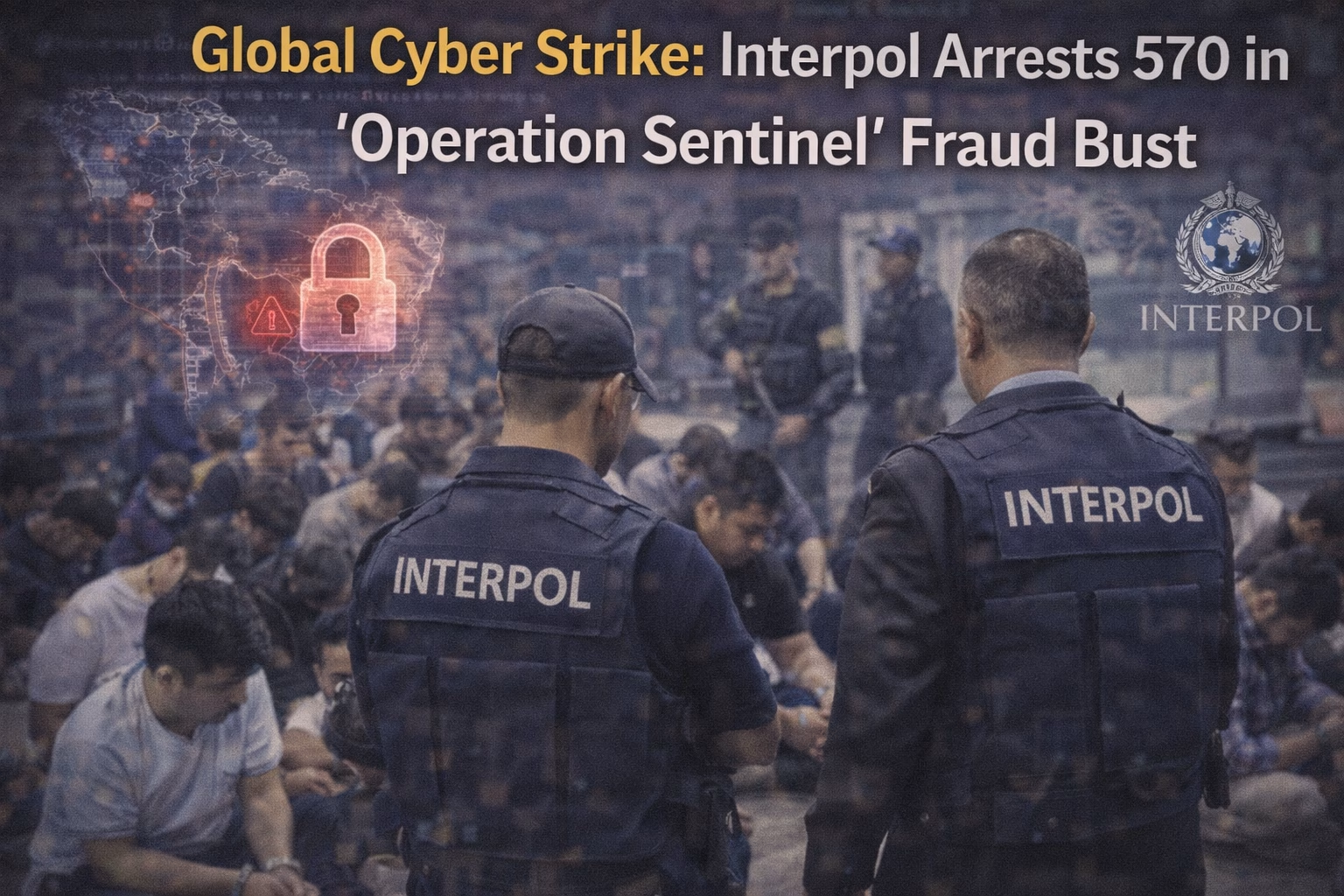
Background and Timeline: Interpol concluded a major month-long international strike titled “Operation Sentinel” on Tuesday, January 27, 2026. The operation was part of the African Joint Operation Against Cybercrime and targeted criminal activities throughout late 2025 and early 2026. The coordinated effort involved 19 African nations and international partners, marking one of the most successful regional crackdowns on organized digital crime.
Modus Operandi: The operation focused on three primary crime categories: Business Email Compromise (BEC), digital extortion, and ransomware. In Senegal, fraudsters used the internal email system of a petroleum company to impersonate executives and authorize $8 million in fraudulent wire transfers. In Ghana, a ransomware syndicate encrypted 100 terabytes of data at a financial institution and demanded $120,000 for decryption.
Victims and Financial Impact: Operation Sentinel successfully recovered over $3 million in stolen funds and shut down more than 6,000 malicious digital links used for phishing. The $8 million wire transfer in Senegal was stopped just before the criminals could withdraw the funds, preventing a massive economic shock to the national energy sector. In Ghana, authorities developed a custom decryption tool that restored nearly 30 terabytes of data.
Investigation and Agencies Involved: The investigation was spearheaded by Interpol’s Director for Cybercrime, Neal Jetton, in coordination with national security forces in Benin, Ghana, and Nigeria. Authorities took 30 fraudulent servers offline and confiscated more than 100 digital devices for forensic auditing. In Benin alone, police took down 43 malicious domains and over 4,300 social media accounts linked to extortion schemes.
Arrests and Suspects: A total of 570 suspected cybercriminals were arrested across the continent during the month-long operation. This includes the arrest of 10 people in Ghana and 106 individuals in Benin involved in complex extortion rackets. Investigators noted that many of the suspects were part of the “Yahoo Boys” network—teenagers trained by professional operators to execute high-volume online scams.
Broader Implications and Trends: Neal Jetton emphasized that the “scale and sophistication” of cyberattacks across Africa are accelerating, especially targeting the finance and energy sectors. The operation demonstrates that “networked policing” is the only effective way to fight transnational syndicates that exploit the region’s expanding mobile networks. Interpol warned that the lack of local cybersecurity education continues to leave millions of people vulnerable to social engineering.