

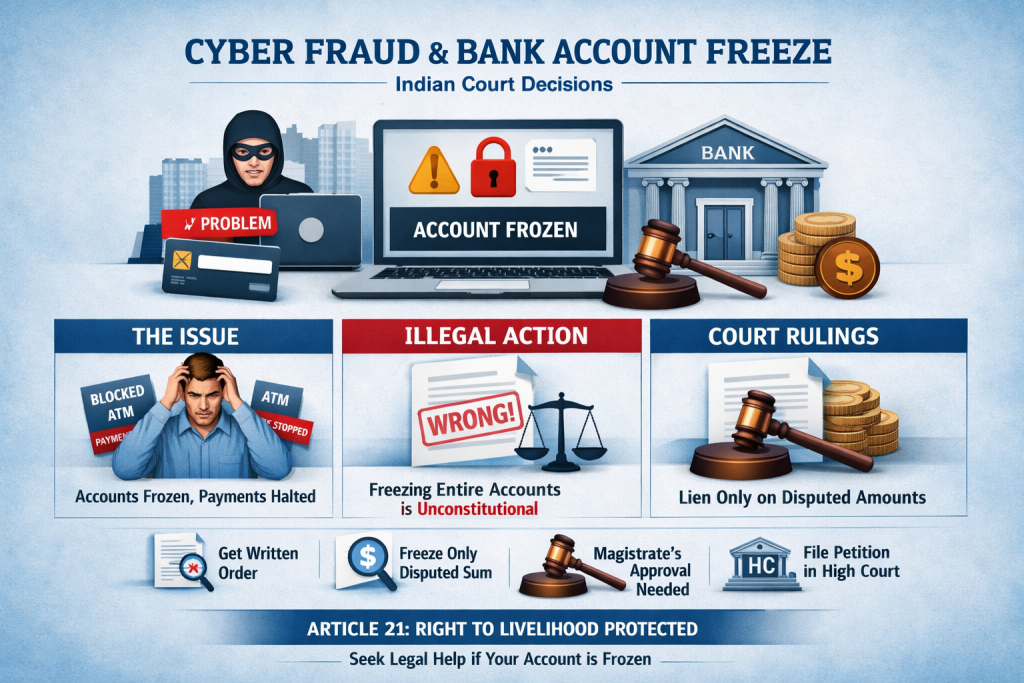
Cyber Fraud & Bank Account Freezing — Indian Court Judgments
Legal Analysis · Cyber Law India
Cyber Fraud & Illegal Bank Freezes
How Indian courts — from Delhi to Bombay, Rajasthan to Madras — are pushing back against the blanket freezing of innocent people’s bank accounts in cyber-crime investigations.
📅 June 2026⚖️ 6 Landmark Judgments🏛️ BNSS · CrPC · Article 21
Important Notice: If your bank account has been frozen without any FIR or notice against you, you may have a legal remedy. Courts have repeatedly held that blanket freezes without specifying the disputed amount are illegal and unconstitutional.
You wake up one morning to find your bank account frozen. No FIR against you, no notice served, no crime committed — yet your salary, your business funds, your EMIs are all blocked. This is the reality thousands of Indians face every year as police investigate cyber fraud cases by ordering sweeping bank account freezes that catch innocent third parties in the net.
Over the last two years, High Courts across India have delivered a series of powerful judgments correcting this practice. The message is clear: investigating agencies cannot freeze entire bank accounts of innocent people simply because a fraud transaction passed through them. Here is a comprehensive look at the key rulings shaping this area of law.
Landmark Judgments
What the Courts Have Said
Delhi HC
Neelkanth Pharma Logistics Pvt. Ltd. v. Union of India
2025 SCC OnLine Del 1055 · Decided 20-02-2025
Facts of the Case
HDFC Bank froze Neelkanth Pharma’s account on directions from Vartaknagar Police Station, Thane — because a suspicious amount of ₹200 had been credited to the account. At the time of freezing, the account held a legitimate withdrawable balance of ₹93.50 crore. The company had no role in any cyber fraud; it was neither accused nor a suspect.
Court’s Ruling
The Delhi High Court held that freezing an entire account without any evidence of the account holder’s complicity in cyber-crime violates Article 21 of the Constitution — the right to livelihood. The Court directed that a lien on the disputed amount should be the first and foremost option, not a blanket freeze. The freeze was lifted; only a ₹200 lien was placed.
Bombay HC
Kartik Yogeshwar Chatur v. Union of India
2025 SCC OnLine Bom 4778 · Decided 20-11-2025
Key Issue
Whether investigating agencies under the Bharatiya Nagarik Suraksha Sanhita (BNSS) 2023 can “debit freeze” entire bank accounts involved in cyber fraud transactions.
Landmark Ruling (Nagpur Bench)
A Division Bench of Justices Anil Pansare and Raj Wakode held that investigating agencies cannot debit freeze an entire bank account under Section 106 BNSS. Only the disputed amount can be placed on lien. The remaining balance must stay fully operational. Debit freeze renders the entire account inaccessible — that is now illegal.
Delhi HC
Malabar Gold & Diamonds Ltd. v. State (Cyber Fraud Transactions Case)
2026 SCC OnLine Del · Decided Feb 2026
Facts of the Case
Malabar Gold sold gold to a company (Dallas E-com Infotech) that was later found to be a cyber fraud accused. Police froze Malabar Gold’s accounts — worth over ₹80 lakh — despite no FIR, no summons, and no allegation against Malabar Gold itself. The company was never even informed why its accounts were being frozen.
Court’s Ruling
Justice Purushaindra Kumar Kaurav held the freeze unjustified and illegal. The mere fact that a customer committed fraud cannot justify freezing an innocent party’s accounts. Debit freeze without a Magistrate’s order under Section 107 BNSS has no legal basis. Accounts must be unfrozen immediately.
★ Especially Relevant — Rajasthan
Rajasthan High Court Ruling (December 2025)
A Jaipur trader’s account was frozen after a cyber-fraud FIR, despite having no role in the crime — he could not pay suppliers, worker salaries, or even his son’s school fees for weeks. The Court intervened strongly:
Ruling
Banks can freeze only the disputed amount, not the entire account. The remaining balance must remain fully accessible to the account holder. If police do not specify the disputed amount in their freeze order, banks must seek written clarification within 7 days — failing which the freeze direction is unenforceable.
Madras HC
Mohammed Saifullah v. Reserve Bank of India & Ors.
2024 SCC OnLine Mad
Ruling
Agencies cannot freeze an entire bank account without quantifying the suspected amount or period. Doing so violates fundamental rights. Only the specific suspected amount may be frozen.
Allahabad HC
Khalsa Medical Store v. Reserve Bank of India & Ors.
2025 SCC OnLine All
Ruling
Investigators must promptly notify the bank of full details of the alleged offence. Banks are allowed to reject unsupported freeze requests. Blanket freezes without specification of the offence are arbitrary and illegal. Authorities must also share case details with the Magistrate.
The Law
Section 106 vs Section 107 BNSS — What’s the Difference?
The Bharatiya Nagarik Suraksha Sanhita (BNSS) 2023 replaced the CrPC. Two sections are crucial in bank freeze cases:
Section 106 BNSS
Gives police power to seize property for evidentiary purposes during investigation. Courts have held this does not authorise debit-freezing or attaching bank accounts.
Section 107 BNSS
The correct provision for attaching or freezing accounts. Requires an order from a competent Magistrate — not just a police letter to a bank. This is the mandatory procedure.
The Supreme Court has upheld the Kerala High Court’s view in Headstar Global (P) Ltd. v. State of Kerala (2025): after the enactment of BNSS, proceeds of crime can be frozen only under Section 107, with a Magistrate’s order.
Key Distinction
Lien vs. Debit Freeze
| Aspect | Lien (Correct Method) | Debit Freeze (Now Illegal) |
|---|---|---|
| What is blocked | Only disputed amount | Entire account balance |
| Account usability | Remaining funds fully accessible | Account completely inaccessible |
| Impact on innocent holder | Minimal — daily life unaffected | Severe — salaries, EMIs, business disrupted |
| Legal authority required | Police communication (with specific amount) | Magistrate order under Sec. 107 BNSS |
| Court verdict | Permissible | Illegal under BNSS |
Ground Reality
Why Does This Keep Happening?
Courts have flagged this problem repeatedly, yet blanket freezes remain common. Here is why the practice persists, and why it is hard to stop:
🔴 Cyber fraudsters move fast. In UPI fraud cases, money jumps from account to account within minutes. Police must act immediately or the funds vanish — which creates pressure to freeze first, verify later.
🔴 Police emails are generic. Most freeze orders simply say “freeze the account” with no amount specified. Banks, out of caution, block everything rather than risk liability for not acting.
🔴 Innocent intermediaries get caught. Fraudsters deliberately route money through legitimate accounts — grocery stores, pharmacies, gold shops — making those account holders unwitting links in a chain. Courts have consistently held that being a payment conduit does not equal guilt.
🔴 AML systems over-freeze. Banks’ own Anti-Money Laundering algorithms sometimes trigger full debit freezes instead of ring-fencing the disputed credit.
Action Points
What You Should Know If Your Account Is Frozen
- 1 Demand the freeze order in writing. You are legally entitled to know the reason. Courts have held that account holders must be informed of the specific reason for freezing — a vague “cyber fraud” tag is not enough.
- 2 Check if a specific amount was specified. If the police order did not specify the disputed amount, the freeze is likely illegal. Ask the bank to seek clarification from the investigating agency within 7 days.
- 3 Verify if a Magistrate’s order exists. Under Section 107 BNSS, attachment of accounts requires a Magistrate’s order — not just a police email. If none exists, file a writ petition before the High Court.
- 4 File a Writ Petition under Article 226. High Courts across India have been receptive to petitions challenging arbitrary bank freezes. Relief has been granted quickly in many cases, often within weeks.
- 5 Request a lien instead of a freeze. Even if some amount must be held, courts have said a lien on only the suspected amount is the appropriate interim measure — not a blanket freeze of your entire balance.
Conclusion
The Courts Are Drawing a Clear Line
From Delhi to Bombay, Rajasthan to Madras, courts are sending a consistent message: investigating agencies and banks must stop treating innocent account holders as criminals simply because fraud money passed through their accounts. The law — both under the old CrPC and the new BNSS — does not permit blanket freezes without specifying the disputed amount, and it certainly does not permit account attachment without a Magistrate’s order.
The right to livelihood under Article 21 of the Constitution is not a casualty of cyber-crime investigations. Innocent people deserve to pay their salaries, their EMIs, their rent — even while police trace the real fraudsters.
If your account has been frozen arbitrarily, you are not without remedy. The High Courts of India have shown they will act.
© 2026 Legal Awareness Blog · For informational purposes only. Not legal advice.
Consult a qualified advocate for your specific situation.
Cases cited: Neelkanth Pharma (Del HC 2025) · Kartik Chatur (Bom HC 2025) · Malabar Gold (Del HC 2026) · Mohammed Saifullah (Mad HC 2024) · Khalsa Medical (All HC 2025) · Headstar Global (SC 2025)