

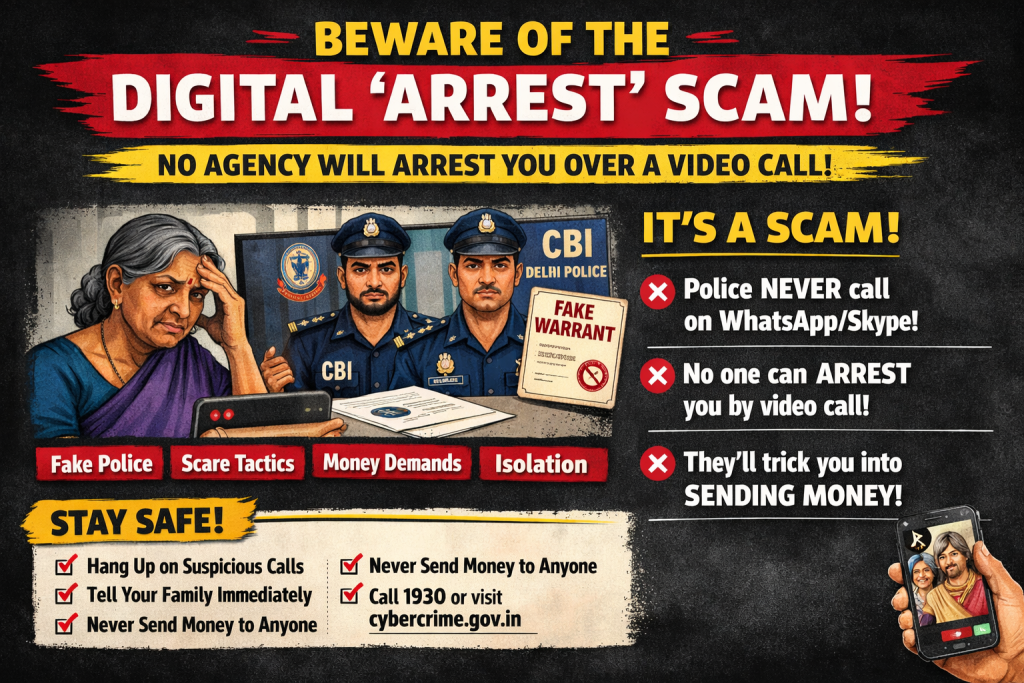
“Digital Arrest” for 37 Days: How Scammers Stole ₹1.58 Crore from a Retired Woman by Pretending to Be Delhi Police
A 69-year-old retired laboratory technician in Gwalior spent over a month of her life in pure terror — unable to speak freely, constantly watched on video, convinced she was a criminal. She wasn’t. She was a victim of one of India’s most ruthless cyber scams: the “digital arrest.”
What Happened — The Case at a Glance
On May 10, 2026, Meenakshi Nakhre, a resident of Sardar Patankar Sahib Ka Bada in Gwalior, received a phone call from a man who identified himself as “Ashok Gupta,” an officer from the telecom department in Delhi.
The caller told her that a mobile number and a bank account had been opened in her name and were allegedly being used for money laundering and illegal activities. When she denied any knowledge of this, the caller threatened that she would be arrested if she did not travel to Delhi within two hours.
What followed was a nightmare that lasted 33 to 37 days — during which Meenakshi transferred a total of ₹1.57–1.58 crore through RTGS to multiple bank accounts spread across more than 10 cities in four states.
₹1.58 Cr Total amount stolen via RTGS transfers
37 Days Duration of psychological captivity
10+ Cities Bank accounts spread across 4 states
69 Yrs Age of the victim — a retired government worker
How the Scam Unfolded — Step by Step
Step 1 — The Hook (May 10)A call from a fake “telecom officer” claimed her name, mobile number, and bank account were tied to a money laundering case under investigation.
Step 2 — The EscalationCallers “transferred” her to fake CBI and Delhi Police officers who showed fabricated warrants, fake case numbers, and official-looking backdrops on video calls.
Step 3 — Digital ImprisonmentShe was placed under continuous video surveillance and told she must not speak to family or friends — or she would be immediately arrested. This is the “digital arrest.”
Step 4 — The TransfersUnder extreme psychological pressure, she transferred money in multiple installments via RTGS — told it was needed to “verify” her accounts and would be returned in full.
Step 5 — The False PromiseOn June 11, the fraudsters told her the “investigation” was complete and a No Objection Certificate (NOC) would be delivered to her home by June 18.
Step 6 — The DisappearanceAfter the night of June 16, every phone number used by the scammers went completely silent. Suspicious, Meenakshi went to Barakhamba Police Station in Delhi — where she was told she had been scammed.
What Is a “Digital Arrest”?
A “digital arrest” has no legal standing whatsoever in India. It is a completely fabricated tactic invented by cybercriminals. No real agency — not the CBI, not the ED, not the police — can arrest you over a WhatsApp video call, hold you under video surveillance at home, or demand money to “clear your name.” The moment you hear these words, it is a scam. Full stop.
This Is Not an Isolated Case — India Is Facing an Epidemic
The Gwalior case is shocking, but it is tragically not unique. Digital arrest scams have become one of the most devastating forms of cyber fraud targeting senior citizens across India in 2025–26.
- An 89-year-old retired Indian Air Force officer in Gwalior — kept under digital arrest for 24 days — lost ₹2.52 crore.
- A 77-year-old retired pediatrician in Delhi lost over ₹13–14 crore.
- A 92-year-old Delhi resident lost ₹2 crore.
- A woman in Mangaluru lost ₹1.80 crore.
“In 2025, Indians filed more than 30,000 digital-arrest complaints, with the Supreme Court estimating nationwide losses near ₹3,000 crore for the year alone. Total cyber fraud losses in India reached ₹22,495 crore ($2.7 billion) in 2025 — with 2.81 million total complaints filed, up 24% from the year before.” — I4C / Ministry of Home Affairs, 2025 Data
The victims are overwhelmingly educated, elderly, and living alone — people who respect authority, fear legal consequences, and are less familiar with how digital fraud works. The scammers know exactly who to target.
How the Scammers Make It Feel Real
What makes digital arrest scams so effective — and so cruel — is the psychological sophistication of the operation. These are not amateur callers. They are organized, scripted, and methodical.
Tactics Used by Digital Arrest Scammers
- Fake police station or courtroom backdrops on video calls — uniforms, flags, and official insignia
- Fabricated arrest warrants with official-looking case numbers and government seals
- Multiple “characters” — caller, supervisor, CBI officer, fake judge — to simulate legitimacy
- Constant video surveillance to prevent the victim from thinking independently or seeking help
- Isolation — threats that contacting family will result in immediate arrest of relatives too
- Urgency — “transfer in 2 hours or face arrest” — designed to completely bypass rational thinking
- False promises — “money is held in an RBI-verification account and will be returned”
- Fake NOC or clearance documents sent to extend the scam and extract further transfers
What Authorities Are Doing
Following the Gwalior complaint, the Cyber Cell has begun freezing bank accounts linked to the fraud. Gwalior SSP Dharmveer Singh confirmed the investigation is underway.
At the national level, the Indian Cyber Crime Coordination Centre (I4C) partnered with Microsoft to block over 1,000 Skype IDs used in digital arrest scams. In 2025, authorities deactivated 1.2 million SIM cards, froze 1.33 million mule accounts, and recovered ₹5,489 crore. The Department of Telecom’s Chakshu / Sanchar Saathi platform allows citizens to report suspicious calls and SMS in real time.
The RBI is also considering adding deliberate delays on large first-time transfers and a potential transaction kill switch — to slow down fraud before money disappears permanently into scammer networks.
How to Protect Yourself and Your Family
Protection Checklist
- If you receive a call claiming you are under investigation — hang up immediately. No real agency calls like this.
- Never stay on a video call under orders. “Digital arrest” has zero legal basis in India.
- Tell a trusted family member immediately. Scammers rely on isolation — break it the moment you can.
- Never transfer money under pressure — not to “verify” your account, not to “clear your name,” not for any reason a stranger demands over the phone.
- Real CBI, ED, and police officers will never contact you over WhatsApp, Skype, or a private video call.
- If someone shows you an “arrest warrant” on a video call — that is the scam. Disconnect immediately.
- Share this information with elderly parents and relatives. They are the primary targets.
1930 National Cyber Crime Helpline
If you or someone you know has been targeted, call 1930 immediately or report online at cybercrime.gov.in. The faster you report, the better the chance of freezing accounts before money is moved further. Do not wait. Do not feel ashamed.
The Bigger Picture
Meenakshi Nakhre’s story is heartbreaking — but her courage in filing a complaint is exactly what is needed. Too many victims stay silent out of shame. There is nothing to be ashamed of. These are highly organized criminal networks using sophisticated psychological manipulation. They have fooled doctors, engineers, retired military officers, and educated professionals across India.
The real lesson here is simple:
No government agency in India will ever arrest you over a video call or ask you to transfer money to prove your innocence.
End the call. Then dial
1930
National Cyber Crime Helpline | cybercrime.gov.in