

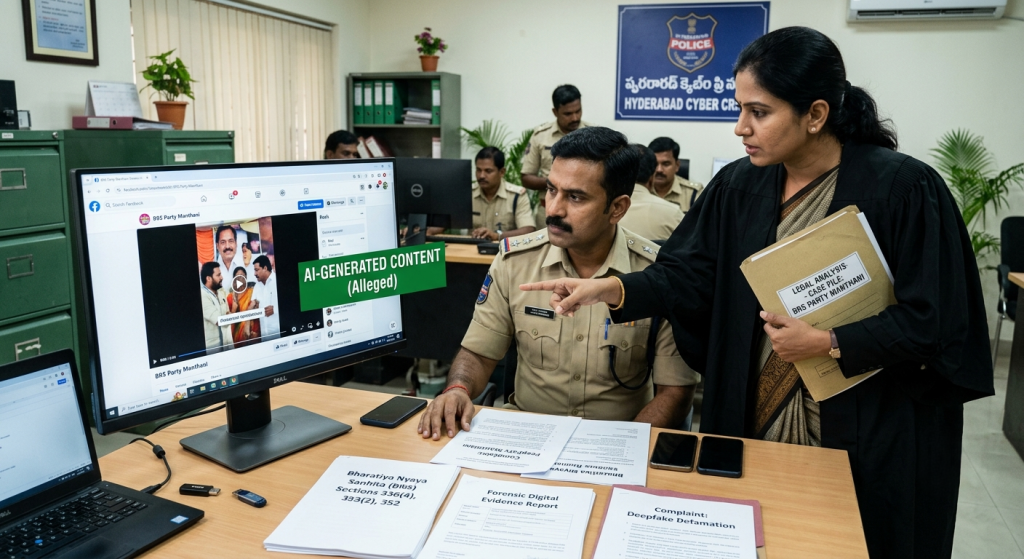
How a single FIR from Hyderabad’s cyber crime police exposes the doctrinal seams of forgery law, defamation jurisprudence, and India’s still-thin case law on synthetic media.
Jurisdiction — Telangana, IndiaStatute — Bharatiya Nyaya Sanhita, 2023Status — Unsettled / Developing
The Facts
The Hyderabad cyber crime police have registered a case against the administrators of the Facebook page “BRS Party Manthani” over a reel alleged to contain AI-manipulated visuals targeting Telangana Industries Minister D. Sridhar Babu and Endowments Department Principal Secretary Shailaja Ramaiyer.
The complaint was filed by advocate Shashi Bushan Kashe, who alleged the reel combined abusive language, derogatory captions, and manipulated imagery to build a narrative of corruption, embezzlement, and illegal enrichment — a narrative the complainant characterises as constructed rather than documented.
Why this matters
Not because the facts are unusual, but because the case sits at the exact point where three unsettled strands of Indian law intersect: forgery provisions drafted long before generative AI existed, defamation jurisprudence built around the printed or spoken word, and a still-thin body of case law on synthetic media.
Which Statutory Provisions Are Actually Doing the Work
The FIR rests on three BNS provisions. Each carries a different evidentiary logic, and each is being asked to do work it was not obviously designed for.
336(4)
Forgery to Harm Reputation
The direct successor to Sections 465/468 IPC, with an aggravated limb for forgery intended to damage reputation. “Forgery” traditionally contemplates a false document or false electronic record made with intent that it be used as genuine — a concept built for physical and textual documents, now being stretched over AI-synthesised imagery.
353(2)
Public Mischief
Covers statements likely to create enmity, hatred, ill-will, or public mischief. Its inclusion frames the content as a matter of broader destabilising public effect, not merely private reputational harm — a framing that could sustain state prosecution independent of any civil defamation claim by the individuals concerned.
352
Circulating False Information
The newer, more directly relevant provision for misinformation cases. It does not require proving forgery in the technical sense — only that false information was circulated with the requisite knowledge or intent — which is likely to make it the workhorse charge in future AI-content prosecutions.
The Doctrinal Gap Behind Section 336
Prosecutors applying Section 336 to an AI-generated image face a threshold question that has not been fully tested: does a synthetic image constitute a “false electronic record” within the meaning of the section, or does the provision require something closer to a fabricated document purporting to be authentic?
This is precisely the kind of interpretive gap that early deepfake-adjacent cases will start to fill. Until higher courts weigh in, prosecutors and defence counsel alike are, in effect, litigating in a doctrinal vacuum — importing forgery concepts built for physical and textual documents into a visual-synthesis context.
The Absence of a Dedicated Deepfake Statute
India still has no standalone legislation criminalising deepfakes or synthetic political content as such. The IT Rules, 2021 (as amended) impose due-diligence and takedown obligations on intermediaries with respect to synthetically generated content, but they regulate platforms, not the creators of the content directly. The consequences of non-compliance run primarily against an intermediary’s safe-harbour protection under Section 79 of the IT Act, not against the poster.
That leaves cases like this one to be built entirely on general-purpose criminal provisions — forgery, defamation-adjacent offences, and public mischief — applied by analogy to a technology those provisions never contemplated.
What This Means for Practitioners
- Evidentiary burden is unusually high. The complainant will likely need forensic digital evidence establishing that the content was, in fact, AI-generated or manipulated — going beyond assertion. Expect this to turn on expert testimony regarding metadata, generation artefacts, or platform-level provenance signals.
- Attribution to page administrators is a separate hurdle. Establishing who controls “BRS Party Manthani” — as opposed to who merely engaged with or shared the content — will require IP logs, platform disclosures under the IT Act’s intermediary cooperation provisions, and potentially mutual legal assistance if administrators are outside India.
- The forgery charge is the most legally fragile of the three. This is where a defence is most likely to find room to argue that Section 336 doesn’t cleanly extend to AI-synthesised imagery absent a “document” in the traditional sense.