

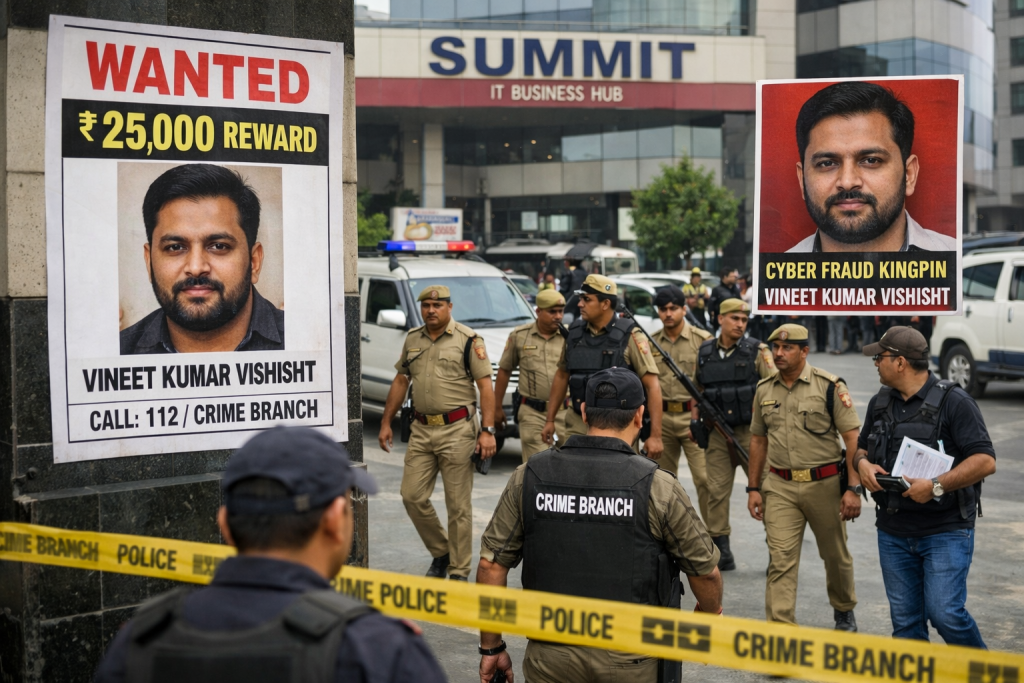
A high-rise office in Gomti Nagar, 119 arrests, and one absconding kingpin now being chased across state lines — the manhunt for Vineet Kumar Vishisht shows both the scale of India’s fake call centre economy and the legal machinery trying to catch up with it.
119 Arrested at Summit Building
₹25,000 Reward on the kingpin
8 Officers dispatched to West Bengal
11th floor Location of the fake call centre
What Happened
The Lucknow Police Commissionerate’s Crime Branch has announced a ₹25,000 reward for information leading to the arrest of Vineet Kumar Vishisht, the absconding alleged kingpin of an international cyber fraud syndicate that operated out of the city’s Summit Building in Gomti Nagar. An eight-member police team has been dispatched to West Bengal to track him down, with sources indicating he has remained on the run since police dismantled the operation, which investigators have dubbed a “Mini Jamtara” — a reference to the notorious cybercrime hub in Jharkhand.
The case originates from a late-night raid on an 11th-floor office in the Summit Building, where a fake call centre operating under the name “Solaris Solutions” was busted. Lucknow Police Commissioner Amrendra Kumar Sengar said the operation resulted in the detention of 119 individuals — 92 men and 27 women — believed to be working the phones as part of a scheme impersonating employees of major US-based tech firms and federal agencies to defraud American citizens. The raid was carried out jointly by the Cyber Crime Cell and Cyber Crime Police Station, under the supervision of a team of senior officers including Additional Deputy Commissioner of Police Kiran Yadav, who has since drawn attention as the officer credited with leading the operation.
Investigators found the office ran almost entirely at night — dark through the Indian business day and fully operational from around 7 PM, synchronised to US working hours — equipped with VoIP calling systems, over a hundred high-specification laptops, more than a hundred dedicated calling phones, and extensive digital records tracking victims and payments.
Who Investigators Are Chasing
Vineet Kumar Vishisht is identified as the syndicate’s kingpin — the figure investigators believe organised and financially benefited from the Solaris Solutions operation, as distinct from the 119 individuals arrested at the call centre itself, most of whom are believed to have been working as callers or operators rather than organisers. His disappearance since the raid, and the deployment of a dedicated eight-officer team to West Bengal, suggests investigators have specific intelligence placing him there, rather than a broad speculative search.
The gap between the 119 arrested and the one still absconding is the legally significant part of this case: the people easiest to arrest are almost always the operators at the bottom of the structure, while the person who built and profited from it is the hardest to catch — and the one whose prosecution matters most for actually dismantling the network rather than just one branch of it.
The Legal Framework at Play
Bharatiya Nyaya Sanhita, IT Act, and Telecommunications Act — the charging trifectaPolice have registered the case under provisions of the BNS, the Information Technology Act, and the Telecommunications Act, reflecting how modern Indian cyber fraud prosecutions typically stack multiple statutes: cheating and conspiracy under BNS, computer-resource-based impersonation under IT Act Sections 66C/66D, and unauthorised or fraudulent use of telecom infrastructure (VoIP systems, calling numbers) under the Telecommunications Act, 2023.
Cross-border victim jurisdictionBecause the alleged victims are US nationals, this case sits at the intersection of Indian criminal law and international cooperation frameworks. India can prosecute the fraud domestically regardless of where the victims are located, since the offence originated from Indian territory — but recovering funds for foreign victims, or extraditing/prosecuting any US-based facilitators, would require Mutual Legal Assistance Treaty cooperation with US authorities, likely including the FBI and FTC given the impersonation of federal agency identities.
Proclaimed offender proceedingsIf Vishisht continues evading arrest despite police efforts, investigators can move to have him declared a “proclaimed offender” under the Bharatiya Nagarik Suraksha Sanhita (the BNSS provision replacing the old CrPC Section 82 process), which allows courts to initiate proceedings against an absconder in absentia and permits attachment of his property — a tool often used precisely in cases like this, where a mastermind’s personal assets are one of the few available levers while he remains physically untraceable.
Reward notifications and their legal basisCash rewards for information on absconding accused are typically issued under state police reward-notification frameworks, and are legally distinct from bail or immunity — an informant is not thereby exempted from liability if they themselves participated in the offence. The modest ₹25,000 figure (relative to the scale of the alleged fraud) suggests either an initial incentive likely to be escalated if the manhunt continues, or reflects the specific, narrow objective of generating location intelligence rather than broader public appeal.
Why “Mini Jamtara” Matters as a Description
The Jamtara comparison isn’t incidental — it signals a specific investigative concern. Jamtara, in Jharkhand, became internationally known as a geographic hub where phishing and social-engineering fraud were run at a semi-industrial scale from ordinary residential buildings, often training and rotating a rotating cast of young operators under a small number of organisers. Labelling the Summit Building operation a “Mini Jamtara” suggests investigators see a similar template here: a high volume of relatively low-skilled callers executing a script, working under organisational leadership that captures the actual profits and bears the actual criminal culpability for designing the fraud.
That framing matters legally because it should inform how the 119 arrested individuals are eventually treated at trial relative to Vishisht, if and when he’s caught. Treating every arrested caller with the same severity as the alleged architect of the scheme risks both an unjust outcome for lower-level participants who may have had limited knowledge of the fraud’s full scale, and a diluted prosecutorial focus on the person whose conviction would do the most to deter future “mini Jamtara” replication elsewhere.
What This Case Signals
- High-rise office fraud is displacing the residential-hub model. Unlike Jamtara’s cottage-industry origins, this operation ran from an 11th-floor commercial office under a seemingly legitimate business name — a sign that fake call centres are adapting to look increasingly like ordinary corporate tenants, complicating detection by building management or casual observation.
- Government-impersonation scams targeting foreign nationals are a distinct, high-yield category. Callers posing as US tech company or federal agency employees represent a more sophisticated variant of fraud than routine phishing, requiring scripted familiarity with US bureaucratic and corporate structures — suggesting organised training, likely under precisely the kind of leadership Vishisht is accused of providing.
- Manhunts for financial kingpins increasingly cross state lines within India itself. The West Bengal deployment illustrates that domestic jurisdictional fragmentation — the same problem that hampers victim-side fraud investigations — cuts both ways, also complicating the pursuit of the accused once they relocate across state borders.
Conclusion
The Summit Building case is likely to be remembered less for the 119 arrests than for what happens with the one person still missing. Dismantling a fraud call centre disrupts one operational site, but only the successful prosecution of its organiser tests whether Indian law enforcement can reach the people who actually design, finance, and profit from these networks — rather than repeatedly rounding up the interchangeable staff who operate the phones. The reward and the West Bengal deployment show the investigation is treating that distinction seriously; whether it succeeds will be the real measure of this case’s legal significance.