

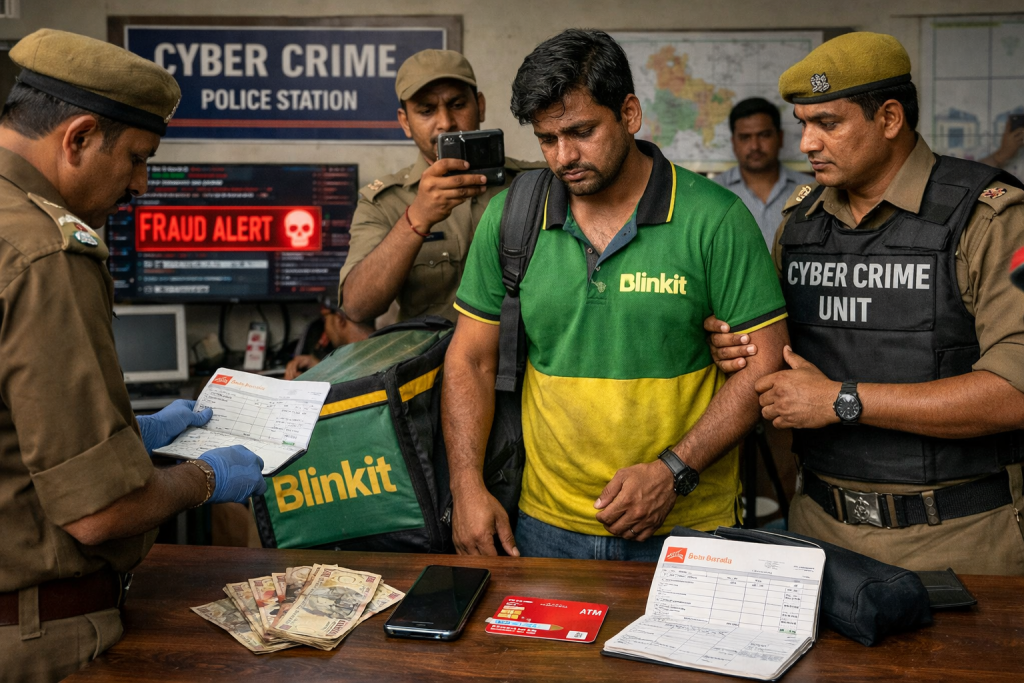
₹2,060 in cash, one Android phone, and a bank account rented out for commission — the arrest in Azamgarh shows how ordinary gig workers are being recruited as the last link in India’s fraud money trail.
Azamgarh, Uttar PradeshCyber Crime Police StationReported July 2026
Cyber Crime Police in Azamgarh have arrested a delivery executive working with quick-commerce platform Blinkit, accusing him of renting out his bank account to a fraud network in exchange for a fixed commission. The case is a small one in monetary terms compared to some recent scams making headlines — but it offers a clear window into the unglamorous, low-tech backbone that keeps India’s cyber fraud economy running: the mule account.
1
Bank of Baroda account flagged
₹2,060
Cash recovered
Varanasi
Where recruitment happened
How He Was Identified
Investigation Trail
The accused, identified as Amit Maurya, a resident of Samdih village in Ambedkar Nagar district, came under scrutiny after investigators flagged suspicious bank accounts through the Pratibimb Portal — a technical system used by Indian cyber crime units to detect accounts linked to fraud complaints. Technical analysis traced one such flagged account, held with Bank of Baroda, back to Maurya. Police say banking transaction records, digital evidence, and technical analysis together pointed to his alleged role in receiving and withdrawing fraud proceeds.
According to investigators, Maurya allegedly came into contact with members of the fraud network while working in Varanasi, and gradually became part of their operations — allowing his bank account, ATM card, and passbook to be used to receive money stolen from fraud victims and then withdraw it as cash. In return, he allegedly received a fixed commission per transaction. Police recovered an Android phone and ₹2,060 in cash from him at the time of arrest.
What Is a “Mule Account,” and Why Does It Matter?
A mule account is a bank account — often belonging to someone with no direct involvement in planning a scam — that is used purely as a pass-through for stolen money. Fraud networks need mule accounts because the money they steal from victims can’t simply sit in the fraudster’s own account; it would be traced and frozen almost immediately. Instead, stolen funds are routed through one or more mule accounts, withdrawn quickly as cash or moved onward, and the account holder is paid a small commission for the use of their identity and banking access.
This is precisely the role investigators allege Maurya played: not a mastermind, but a functional piece of the laundering chain, recruited informally through personal contact with an existing network member rather than through any sophisticated technical recruitment.
Why Gig Workers Are TargetedDelivery and gig-economy workers are increasingly being approached by fraud networks precisely because they are mobile, often need supplemental income, and typically hold ordinary personal bank accounts that don’t attract scrutiny the way business accounts might. A modest, steady commission can look appealing without the person fully grasping the criminal liability they’re accepting.
Not an Isolated Case
Azamgarh’s Cyber Crime Police Station has emerged as an active front in Uttar Pradesh’s fight against fraud networks that rely on mule accounts, with several related cases surfacing in recent months:
Inter-state cash mule from Bihar arrested for laundering funds through fuel pumps and service centres ₹7 lakh
Fake trading app racket busted, with two bank employees among those allegedly supplying pre-signed blank cheques for instant withdrawals~₹1 crore
“Digital arrest” network exposed, using mule accounts, fake SIMs and crypto transfers to move coerced payments ₹34.87 lakh
Taken together, these cases suggest a layered underground economy: some members arrange rented or fake bank accounts, others handle the technical fraud (fake trading apps, impersonation calls, phishing), and still others — sometimes including bank employees themselves — facilitate rapid withdrawal once funds land. The Blinkit executive’s case fits into the first category: the person willing to hand over access to a clean, ordinary-looking bank account.
What Happens Next
Investigators say that based on information obtained during questioning, police are now working to identify and arrest other members of the wider network Maurya is alleged to have been connected to. As with similar cases, the account itself likely served multiple fraud complaints from different victims, which typically complicates both prosecution and the release of any recoverable funds, since several victims’ claims can be tied to the same frozen account.
Why This Should Worry Ordinary Bank Account Holders
- Renting out your account is a crime, not a side hustle. Allowing someone else to use your bank account, ATM card, or passbook to move money — even for a small commission — can make you criminally liable as a party to fraud, regardless of whether you personally scammed anyone.
- “Easy money” offers from acquaintances are a common recruitment method. Many mule account cases begin exactly like this one: an informal approach from someone the person already knows through work, not a stranger online.
- Frozen accounts create real consequences. Once a mule account is flagged, the holder can face account freezes, police investigation, and prosecution — even if the actual planning of the fraud was done entirely by others.
- If you’re approached with such an offer, report it. Suspicious requests to use your bank account for a fee can be reported to the National Cyber Crime Helpline on 1930 or at cybercrime.gov.in.
The case is a reminder that behind every large, headline-grabbing fraud figure — crores lost to fake investment apps, impersonation scams, or digital arrest threats — sits a quieter layer of ordinary people who agreed, for a small cut, to let their names and bank accounts become someone else’s getaway vehicle.