

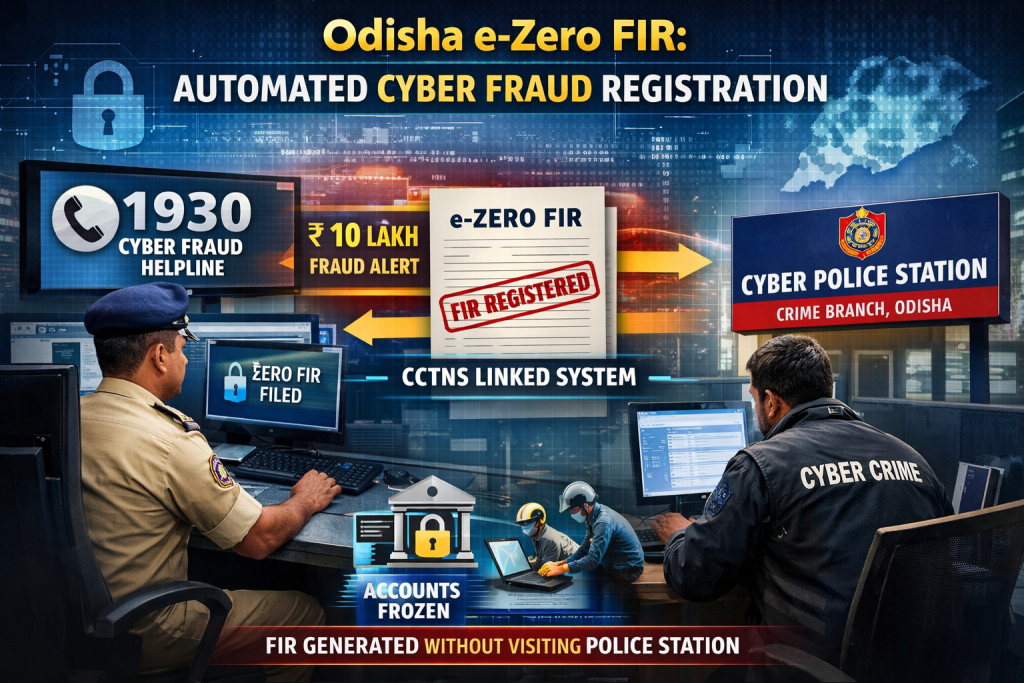
A ₹10 lakh threshold, a live link between the 1930 helpline and the police database, and an FIR generated without a victim ever visiting a station. Odisha becomes the first state to automate Zero FIR registration for cyber financial fraud — here is what the mechanism does, and where its limits sit.
For most cyber fraud victims in India, the first hour after money leaves an account is also the most confusing one. A helpline call registers the complaint, but converting that complaint into a formal FIR — the document that actually authorises police to freeze accounts and pursue a bank trace — has traditionally required a separate visit to a police station, often in a jurisdiction the victim has no connection to. Odisha Police has now moved to close that gap. On Wednesday, DGP Yogesh Bahadur Khurania launched the state’s e-Zero FIR system, automating the link between a cyber financial fraud complaint and formal FIR registration for the first time in India.
System at a Glance
| Launched by | DGP Yogesh Bahadur Khurania, at Odisha Police Headquarters, Cuttack |
| Integration | National Cybercrime Helpline 1930 linked with Odisha’s CCTNS (Crime and Criminal Tracking Network & Systems) |
| Implementing body | State Crime Records Bureau (SCRB), Odisha |
| Trigger threshold | Cyber financial fraud complaints of ₹10 lakh or more reported via 1930 |
| Routing | Automatic e-Zero FIR request sent to the Cyber Police Station, Crime Branch, Odisha |
| Jurisdictional scope | Applies irrespective of where the offence occurred |
How the Mechanism Actually Works
The system is best understood as a procedural bridge rather than a new investigative power. It removes the manual handoff that previously existed between a victim calling the 1930 helpline and a police station formally taking cognisance of the complaint.
Complaint-to-FIR Workflow
| Step | Action |
|---|---|
| 1 | Victim reports a cyber financial fraud of ₹10 lakh or above through the National Cybercrime Helpline 1930 |
| 2 | CCTNS, integrated with the 1930 system, automatically generates an e-Zero FIR request |
| 3 | The request is instantly routed to the Cyber Police Station, Crime Branch, Odisha |
| 4 | After a preliminary check, the Cyber Police Station registers a regular FIR and begins investigation |
| 5 | Based on facts, the case may instead be transferred to the jurisdictional station, linked to an existing case, or closed if criteria are not met |
The design directly targets the delay window that fraud investigators consistently identify as the single biggest determinant of recovery — the gap between a fraudulent transfer and the moment a bank account can legally be frozen. By removing the manual step of a victim physically registering an FIR, Odisha Police is betting that faster paperwork translates into faster freeze requests, and therefore a meaningfully better chance of recovering defrauded funds before they move through several layers of mule accounts.
If you become a victim of cyber financial fraud, do not delay. Report immediately on 1930 — the sooner you report, the faster we can act, and the better your chances of recovering the lost money.— DGP Yogesh Bahadur Khurania, at the system’s launch
The Legal Concept Behind “Zero FIR”
A Zero FIR is not a new category of offence report — it is a jurisdictional workaround. Ordinarily, an FIR is registered at the police station within whose territorial limits the offence occurred. A Zero FIR allows any police station to register a complaint regardless of where the crime took place, assigning it a temporary “zero” number before it is transferred to the appropriate jurisdiction for investigation. This concept, long recognised in Indian criminal procedure and now carried forward under the Bharatiya Nagarik Suraksha Sanhita, is particularly suited to cyber fraud, where the victim, the accused, the mule account, and the server involved may sit in four different states — making the question of “correct” jurisdiction often irrelevant to the urgency of the moment.
What Odisha has added is automation. Rather than requiring a victim or an officer to manually initiate the Zero FIR process, the system now triggers it directly from a verified 1930 helpline complaint above the ₹10 lakh threshold — reducing a jurisdictional safeguard that already existed on paper into something that functions in practice without additional victim effort.
Reading the Threshold — And Its Limits
Why ₹10 Lakh
A monetary threshold allows the system to prioritise high-value fraud for automatic escalation while lower-value complaints continue through the standard 1930-to-police-station process — a reasonable triage given limited cyber police station capacity, though it means smaller frauds do not receive the same automated speed.
Discretion Retained
The Cyber Police Station still exercises judgment after the automatic request is routed — it can register a regular FIR, transfer the case, link it to an existing investigation, or close it if criteria aren’t met. Automation speeds up routing, not the substantive decision to investigate.
Statewide, Not National
The integration currently covers Odisha’s CCTNS specifically. For cross-border cases where the accused or mule account sits outside Odisha, inter-state coordination — historically the slower part of cyber fraud investigation — still depends on cooperation between separate state systems.
Freeze, Not Recovery
A faster FIR improves the odds of a timely account freeze request, but freezing funds and actually recovering them for the victim remain separate, often lengthy, legal processes involving the bank, the court, and sometimes multiple layered accounts.
Part of a Wider Pattern in Odisha
The e-Zero FIR launch follows Odisha Police’s broader “Operation Cyber Kavach,” a sustained campaign against mule bank accounts and organised cyber fraud networks that has, over successive phases, resulted in tens of thousands of mule accounts being flagged and multiple arrests across districts. Seen alongside that campaign, the e-Zero FIR system reads less like an isolated technology launch and more like the next link in a chain the state has been building deliberately — intelligence-led identification of mule accounts on one end, and now automated, jurisdiction-agnostic FIR registration on the other, aimed at compressing the time between a fraud occurring and the legal machinery responding to it.
Advisory — What Victims Should Still Do
- 01Report on 1930 immediately. Automation only helps if the underlying complaint is filed fast — delay before reporting still erodes the chance of a freeze regardless of what happens afterward.
- 02Keep transaction evidence ready. Bank reference numbers, UTR/transaction IDs, screenshots of the fraudulent communication, and account details of the receiving party speed up the preliminary check that precedes FIR registration.
- 03Follow up in writing. An automated system reduces delay but does not remove the value of a written complaint copy for your own records, particularly if you intend to pursue civil recovery or insurance claims alongside the criminal process.
- 04Engage counsel for high-value fraud. For losses near or above the ₹10 lakh threshold, early legal input helps ensure the complaint is framed to trigger the right provisions and that parallel recovery routes — bank chargebacks, civil suits — are not left unexplored.
- 05Track the case status. Ask for the FIR number and cyber police station details once registered; a Zero FIR is only the entry point; active follow-up remains necessary as the case is transferred or investigated further.
If you’ve suffered a high-value cyber financial fraud in Odisha or elsewhere, understanding how Zero FIR registration and the 1930 helpline interact with your state’s systems can materially affect how fast a freeze request reaches the bank. Reach out for a confidential review of your case and the fastest available reporting route.