

The Case at a Glance
The Surat City Cyber Crime Cell has arrested three men from Uttarakhand for their alleged role in a cyber fraud that cost a Surat resident more than Rs 1.63 crore. The victim was lured into a fake gold mining investment scheme, with the fraud reportedly playing out between December 10, 2024 and April 25, 2025.
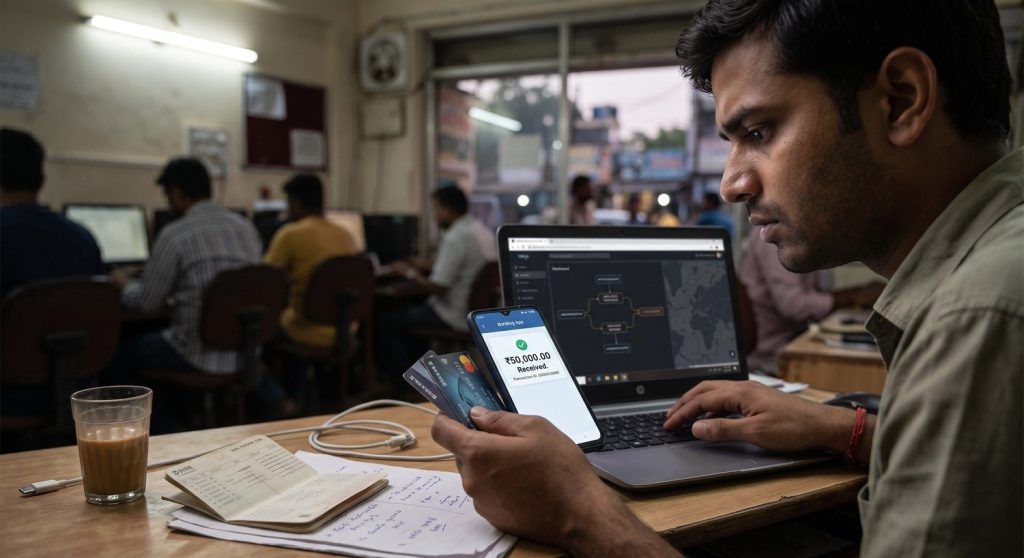
According to investigators, the three accused did not run the scam themselves. Instead, their alleged role was narrower but critical: providing the bank accounts through which the stolen money was moved and laundered. This detail is the real story here, because it points to a pattern that has become disturbingly common in Indian cyber fraud investigations — the rise of “mule accounts” that let organized scam networks operate at scale while insulating the actual masterminds from detection.
How a Fake Gold Investment Scam Typically Works
While the specific script used in this case hasn’t been fully detailed publicly, fake gold and mining investment scams tend to follow a familiar playbook seen across dozens of similar cases in India over the past two years:
- The hook: Victims are added to WhatsApp or Telegram groups, or approached through social media ads, promising unusually high, steady returns from gold trading, gold bonds, or mining ventures.
- Building trust: Early “investments” are often met with small, real payouts or a slick dashboard showing paper profits, encouraging the victim to invest more.
- The escalation: Once the victim is emotionally and financially invested, they’re pushed to transfer larger sums — sometimes framed as taxes, processing fees, or unlocking charges needed to “release” their profits.
- The vanishing act: Eventually, withdrawals stop working, communication dries up, and the operators disappear — often having already moved the money through multiple bank accounts and into cryptocurrency to break the trail.
A four-month fraud window, as seen in this case, is typical of scams designed to slowly drain a victim rather than take one large sum and disappear immediately — the drawn-out timeline itself often serves as reassurance that the “investment” is legitimate.
The Mule Account Problem
The most important detail in this case isn’t the scam pitch — it’s the alleged role of the three men arrested. Police say they supplied the bank accounts used to route the fraud proceeds, rather than running the scam itself.
This is now one of the most common patterns in Indian cyber fraud cases. Organized fraud networks — frequently operating from outside the immediate jurisdiction, and in many well-documented cases from Southeast Asian cyber-scam compounds — need a constant supply of Indian bank accounts to receive victims’ money before it’s withdrawn or converted to cryptocurrency. To get these accounts, they recruit ordinary people, often through job offers or promises of easy commission, and pay them a cut for either opening accounts in their own name or handing over control of existing ones.
For the account holder, the consequences can be severe even if they never directly spoke to the victim. Their account gets frozen, they can face arrest under sections of the Bharatiya Nyaya Sanhita and the IT Act, and they often end up as the most visible, easiest-to-catch link in a chain designed to protect the people actually running the scam.
Why Surat’s Cyber Crime Cell Is Seeing More of These Cases
Surat has emerged as one of the more active cities for cyber fraud investigations in Gujarat, partly a reflection of its dense trading and diamond-business economy, where high-value transactions and investment culture are already part of daily life — making residents attractive targets for investment fraud pitches. The city’s cyber crime cell has handled a steady stream of similar cases in recent months, ranging from fake share-trading schemes to gold-bond frauds, several of which have also traced back to rented or purchased bank accounts from other states.
Red Flags Worth Remembering
Cases like this one offer a useful checklist for anyone evaluating an “investment opportunity” that arrives through a chat group or unsolicited message:
- Unusually high, guaranteed returns. Legitimate gold or mining investments carry market risk; guaranteed high returns are a hallmark of fraud.
- Pressure to act through informal channels. Legitimate investment platforms are registered and regulated — not run entirely through WhatsApp groups.
- Fees required to “unlock” withdrawals. This is one of the most reliable scam signals: real platforms don’t charge you extra money to access money that’s already yours.
- Unverifiable claims about mining leases, gold reserves, or licenses. These can and should be checked against government mining and corporate registries before any money changes hands.
- Requests to transfer money to personal or unfamiliar business accounts rather than a verified, regulated entity.
The Bigger Picture
This arrest is a small piece of a much larger enforcement challenge. Cyber fraud investigators across India are increasingly finding that catching the low-level account holders — while necessary — does little to stop the networks themselves, which often operate across state and national borders and simply recruit new mule accounts once one is frozen. Tackling the problem more fundamentally will likely require closer coordination between banks, telecom companies, and law enforcement to flag suspicious account activity before large sums move through the system, not just after a victim has already filed a complaint.
For now, the case serves as a reminder on two fronts: for potential investors, that “guaranteed” high returns from gold or mining schemes shared in a chat group should be treated with real suspicion, and for anyone tempted by an offer to rent out their bank account for a quick commission, that doing so can carry serious legal consequences even without direct involvement in the fraud itself.