

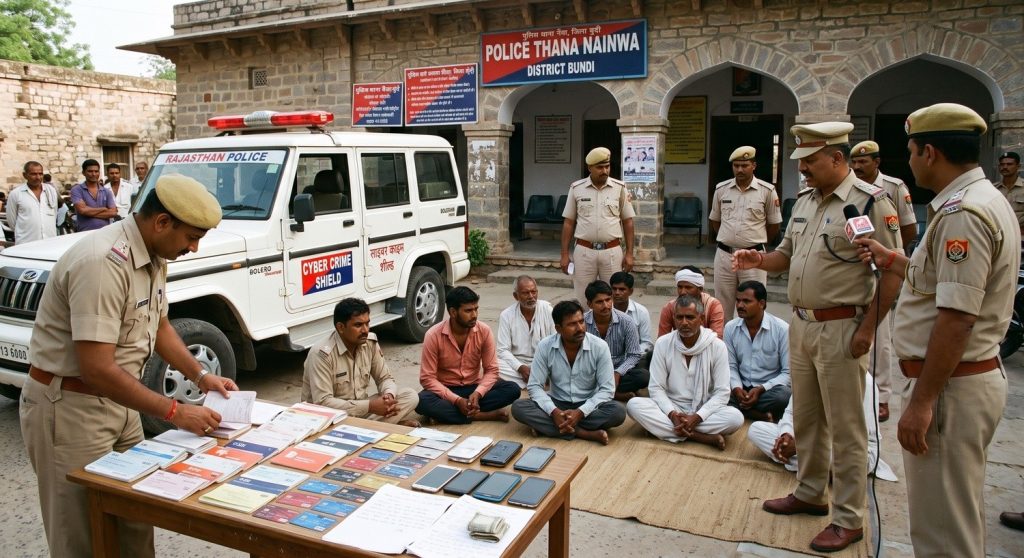
What Happened
In a coordinated operation in the Nainwa area of Bundi district, Rajasthan Police arrested 20 individuals accused of renting out their personal bank accounts to organized cybercrime networks. The arrests were carried out as part of Operation Cyber Shield, a state-wide initiative aimed at dismantling the financial infrastructure that lets digital fraud syndicates operate across Northern India.
Unlike cases that centre on a scam’s mastermind or its call-centre operators, this operation zeroes in on something less visible but arguably just as important: the ordinary bank accounts that let stolen money move, layer, and disappear.
Why This Matters More Than It Might Seem
Most cyber fraud stories focus on the moment of deception — the fake stockbroker, the bogus customs officer, the “digital arrest” call. But every rupee stolen in these schemes needs somewhere to land. That’s where mule accounts come in, and it’s why targeting them, rather than only individual fraud cases, has become a growing priority for Indian law enforcement.
A single mule account can be used to receive money from dozens or even hundreds of victims across different states before it’s frozen. By the time any one victim files a complaint and police trace the money, the account has often already been used to defraud people in several other cities, and the funds have moved on — frequently into cryptocurrency or a maze of further accounts — long before the trail can be followed to the organizers.
This is precisely why “Operation Cyber Shield” and similar efforts frame themselves as targeting financial shadow infrastructure rather than individual scams. Disrupting the supply of usable bank accounts is, in theory, a way to choke off fraud networks at a structural level rather than chasing one case at a time.
How Rural Districts Like Bundi Become Recruiting Grounds
Nainwa and similar semi-rural areas have increasingly featured in mule-account investigations across India, and the reasons tend to be consistent from case to case:
- Easy money framed as harmless. Recruiters often approach people with offers of quick commission for simply “lending” an account for a short period, with the transaction dressed up as a favour or informal job rather than a crime.
- Limited awareness of legal exposure. Many account holders reportedly don’t realize that renting out a bank account can expose them to serious criminal charges, even if they never interact with the eventual victim.
- Weak oversight at account opening. Rural and semi-urban bank branches, agents, and business correspondents can be a weak link where KYC checks are inconsistently enforced, making it easier for handlers to acquire accounts in bulk.
- Networked recruitment. Once one person in a village or community rents out an account, word can spread quickly to relatives and neighbours, allowing handlers to sign up multiple accounts from a single area in a short window — which may explain why a single operation in Nainwa was able to net 20 arrests at once.
The Legal Reality for “Just Renting an Account”
One of the more important messages coming out of operations like this is aimed not at hardened criminals but at people who may see this as a low-risk side income. Someone who hands over a bank account, ATM card, or online banking credentials in exchange for a commission can be prosecuted under provisions of the Bharatiya Nyaya Sanhita covering cheating and criminal conspiracy, as well as under the Information Technology Act. Ignorance of how the account was ultimately used is rarely accepted as a defence, particularly when money trails show a pattern of repeated, suspicious transactions.
For the account holder, the consequences typically include:
- The account being frozen, often for months, cutting off access to their own legitimate funds.
- Being named as an accused, not just a witness, in FIRs filed by victims in other states.
- Facing arrest and having to travel for court appearances far from home, even when they never had direct contact with any victim.
Operation Cyber Shield in Context
Rajasthan has positioned itself as one of the more proactive states on this front, having previously run other named operations against cyber fraud networks, including efforts that uncovered fraud rings with turnover running into thousands of crores. Operation Cyber Shield builds on this template — focused explicitly on tracking down wanted cyber offenders, dismantling mule-account networks, and building a centralized database of cyber criminals for better cross-state coordination.
The choice to conduct synchronised arrests across the Nainwa region, rather than picking off individuals one at a time, reflects how these operations increasingly work: intelligence is gathered on clusters of linked accounts, and arrests are timed together so that suspects can’t tip each other off or move money before police act.
The Bigger Challenge Ahead
Cracking down on mule accounts is necessary, but police officials and cyber security experts have repeatedly pointed out that it treats a symptom rather than the disease. The organizers who recruit account holders, script the frauds, and pocket the bulk of the money frequently operate from outside the immediate jurisdiction — in some well-documented cases, from cyber-fraud compounds based overseas — making them far harder to arrest than the local residents who agreed to rent out an account for a few thousand rupees.
That imbalance raises an uncomfortable question that often follows these operations: are the people facing arrest the ones most responsible for the fraud, or simply the most reachable? Sustainable progress will likely depend on combining account-level crackdowns like this one with stronger bank-level fraud detection, faster interbank freezing of suspicious transactions, and international cooperation to reach the networks directing the scams from a distance.
Takeaway
The Bundi arrests are a reminder that cyber fraud in India runs on more than clever scripts and fake apps — it runs on access to real, working bank accounts, and there is an entire informal economy built around supplying them. For law enforcement, disrupting that supply chain is now treated as being just as important as catching the fraudsters who make the calls. For ordinary citizens, especially in areas where such recruitment is active, the operation sends a blunt warning: renting out a bank account is not a shortcut to easy money — it is a fast track to becoming the face of someone else’s crime.