
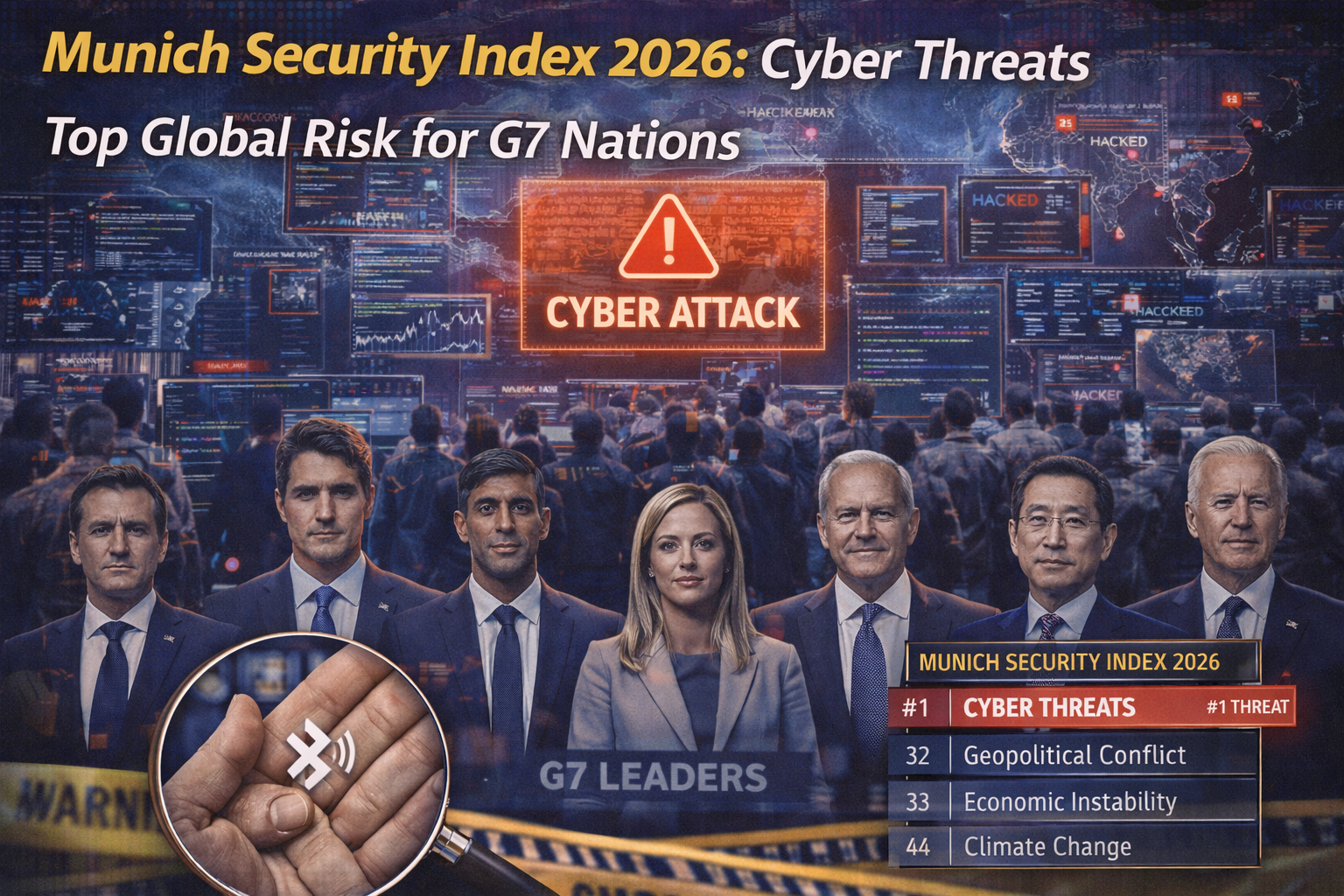
Background and Timeline: Released on February 13, 2026, during the opening of the Munich Security Conference (MSC), the latest security risk report identifies a sharp rise in cyber anxiety. The partners at Kekst CNC released the 2026 edition of the Munich Security Index (MSI) as world leaders gathered in Germany. This marks the second consecutive year that cyber threats have dominated the global risk index.
Modus Operandi: The index captures the threat perceptions of citizens across G7 and BICS (BRICS minus Russia) nations. In countries like Germany, the UK, and Japan, over 70% of respondents identified “cyber-attacks on their country” as one of their nation’s most serious risks. This reflects a growing public awareness of geopolitically motivated cyberattacks targeting critical infrastructure and disinformation campaigns from enemy states.
Victims and Financial Impact: While the index tracks perception, it reflects the multi-billion dollar impact of recent state-sponsored intrusions. In the U.S., perceived risks are tied to economic and political instability, with cyber threats viewed as a core driver of financial crisis. Conversely, in BICS nations, cyber-attacks have fallen to 8th place as “climate change” and “rising inequality” have become more urgent concerns.
Investigation and Agencies Involved: The Munich Security Conference partner consultancy Kekst CNC conducted the multi-nation survey. The findings were presented to delegations that included Governor of Saudi Arabia’s National Cybersecurity Authority Majid Al-Mazyad and other global security chiefs. The data is intended to guide international collaboration on “cyber inequity” and collective resilience imperatives.
Arrests and Suspects: Not applicable (Security report). However, the index highlights that 64% of organizations are now accounting for geopolitically motivated attacks—such as those by Russian and Chinese APTs—in their mitigation strategies. The report calls for a unified global response to “disinformation campaigns,” which G7 nations now rank as their 3rd most critical risk.
Broader Implications and Trends: The MSI 2026 reflects a “widening technological divide” and deep geopolitical fragmentation in cyber defense. It shows that cybersecurity has moved from a technical niche to the top of the G7’s national security agenda. This trend indicates that successful global order now hinges as much on digital stability as it does on economic or military power.