

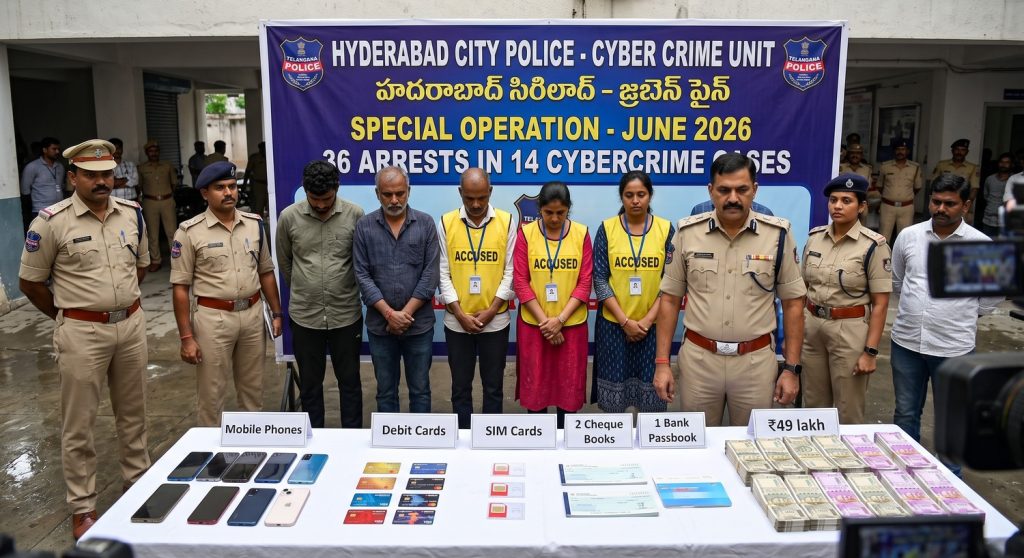
One month, fourteen cases, four distinct categories of fraud, and a recovery operation that reached from Telangana to Delhi. The numbers behind the crackdown say less about a single scam and more about how organised online fraud in India has become.
Asingle month of enforcement activity by the Hyderabad Cyber Crime Police produced 36 arrests spread across five states, ₹48.98 lakh recovered and refunded to victims, and a case list spanning investment schemes, matrimonial deception, fake job offers, and social-media-based extortion. Read individually, these are routine police actions. Read together, they map the current shape of cyber fraud in India — and offer a working checklist for anyone assessing personal or organisational exposure.
Operation at a Glance
| Conducting unit | Cyber Crime Police, Hyderabad City |
| Period | Special operations carried out through June 2026 |
| Cases covered | 14 distinct cybercrime cases |
| Total arrests | 36 accused, apprehended across five states |
| Amount recovered | ₹48.98 lakh, recovered and refunded directly to victims |
| Property seized | 8 mobile phones, 6 debit cards, 3 SIM cards, 2 cheque books, 1 bank passbook |
The Anatomy of the Crackdown: Four Fraud Categories
The 36 arrests break down into four recognisable fraud typologies, each exploiting a different form of trust — financial, romantic, professional, or social. The distribution is itself informative.
Arrests by Fraud Category
| Category | Accused |
|---|---|
| Investment fraud | 22 of 36 |
| Matrimonial fraud | 6 of 36 |
| Social media offences | 5 of 36 |
| Job fraud | 3 of 36 |
Investment fraud alone accounts for well over half the arrests — consistent with a national trend in which fake trading apps, stock-tip channels, and Ponzi-style crypto schemes have overtaken more traditional lottery and OTP scams as the dominant mode of online financial fraud. Matrimonial and job fraud together account for roughly a quarter of cases, both relying on a longer con — weeks of relationship-building on a dating platform or job portal — before the financial ask is made, which typically means larger individual losses per victim even though the arrest counts are smaller.
Where the Accused Were Traced
State-wise Arrests
| State | Accused Apprehended |
|---|---|
| Telangana | 26 |
| Maharashtra | 4 |
| Karnataka | 2 |
| Andhra Pradesh | 2 |
| Delhi | 2 |
| Total | 36 |
The geographic spread — arrests executed in Maharashtra, Karnataka, Andhra Pradesh, and Delhi, all in cases registered in Hyderabad — illustrates a structural reality of cyber fraud investigation in India: the crime is filed in one jurisdiction, but the accused, the mule accounts, and often the victims are scattered across several states. This is precisely why cyber crime units increasingly operate through inter-state coordination teams rather than relying on local police alone, and why complainants should not assume that a case will stall simply because the accused is not based in their city.
Eight mobile phones, six debit cards, three SIM cards, two cheque books, and a single bank passbook — the entire seized toolkit behind fourteen separate cybercrime cases and ₹49 lakh in fraud.— Property seizure record, June 2026 operations
What the Seizure List Tells You About the Fraud Infrastructure
The recovered property — a modest set of phones, SIM cards, debit cards, and a passbook — is worth pausing on. It reflects how little physical infrastructure organised cyber fraud actually requires. A handful of SIM cards, procured through weak KYC verification or purchased from compromised retailers, combined with mule bank accounts opened using rented or stolen identity documents, is sufficient to run parallel scams across multiple states. This is also why enforcement increasingly targets the account layer — freezing and tracing mule accounts — rather than waiting to identify the mastermind of each scheme, since the accounts are often the fastest, and sometimes the only, verifiable link back to the operation.
Legal Exposure Across the Four Categories
Investment Fraud
Typically prosecuted under cheating provisions of the Bharatiya Nyaya Sanhita read with IT Act Sections 66C and 66D, and, where the scheme involves pooling of public money, the Prize Chits and Money Circulation Schemes (Banning) Act or SEBI’s regulatory framework for unregistered investment advice.
Matrimonial Fraud
Charged as cheating and, where a fabricated identity or forged document is used to induce marriage-related payments, may attract provisions on forgery and criminal breach of trust alongside the core cheating offence — with civil recovery options also available against traceable assets.
Job Fraud
Usually prosecuted as cheating combined with IT Act provisions where the offer is extended through fake portals or impersonated recruiter profiles; victims who paid “registration” or “training” fees have grounds for both criminal complaint and civil recovery.
Social Media Offences
Covers a range of conduct from impersonation and defamation to sextortion, engaging IT Act Sections 66C, 66D and 66E alongside relevant BNS provisions depending on whether the offence involves identity theft, harassment, or non-consensual image sharing.
Reading the Recovery Number Correctly
₹48.98 lakh recovered and refunded is a genuinely strong outcome relative to national averages, where recovery rates for cyber financial fraud typically remain well below 15% of the reported loss. It reflects a combination of faster complaint registration, coordinated freeze requests to banks, and the National Cyber Crime Reporting Portal’s escalation mechanisms. But it also implies the inverse: fourteen cases almost certainly involved total losses considerably higher than the recovered sum, meaning a meaningful share of victim funds already moved beyond reach — into further mule accounts, cash withdrawals, or cross-border transfers — before recovery efforts began. The lesson for individuals and businesses alike is the same one that recurs across nearly every cyber fraud case: the speed of reporting, not the sophistication of the eventual investigation, is the single biggest determinant of whether money comes back.
Advisory — Reducing Exposure to These Four Fraud Types
- 01Investment offers. Treat unsolicited trading tips, guaranteed-return schemes, or “VIP” investment groups on WhatsApp and Telegram as high-risk by default; verify any advisor or platform against SEBI’s registered intermediary list before transferring funds.
- 02Matrimonial platforms. Independently verify a prospective match’s identity and background before any financial request; never send money for a stated emergency, customs charge, or medical crisis, however credible the story.
- 03Job offers. Legitimate employers do not charge registration, training, or “refundable security” fees before an offer letter is issued; cross-check the recruiter and company through official channels, not just the number that contacted you.
- 04Social media contact. Lock down profile visibility, be cautious of impersonation accounts using your own or a known contact’s photographs, and report suspicious profiles to the platform immediately rather than engaging.
- 05Report within the golden hour. Call 1930 or file at cybercrime.gov.in the moment fraud is suspected — recovery odds fall sharply once funds move past the second or third layer of accounts.
If you or your organisation has suffered a loss through investment, matrimonial, job, or social-media fraud, early legal intervention — filing the right complaint, coordinating bank freeze requests, and pursuing parallel civil recovery — meaningfully improves outcomes. Get in touch for a confidential review of your case.