

The Humble Beginnings of Esports (1972)
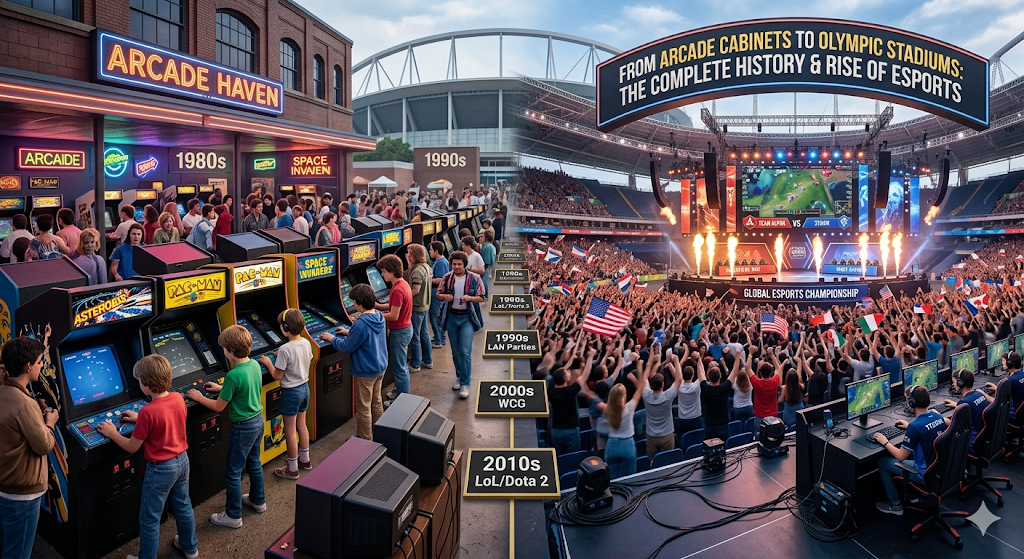
Esports has traveled an extraordinary distance in just over fifty years. What began in 1972 as a small computer-lab contest at Stanford, where a handful of students competed in the Intergalactic Spacewar Olympics for nothing more than a year’s subscription to Rolling Stone, has grown into a global industry valued at over five billion dollars, with audiences spanning hundreds of millions of fans across nearly every continent.
The Arcade Era: When High Scores Made Celebrities (1970s–1980s)
The arcade era of the late 1970s and 1980s turned high scores into a form of celebrity, with shows like Starcade and record-setting tournaments such as Konami’s 1984 Track & Field competition, which drew more than a million participants and still holds a Guinness World Record. As home computers and the internet spread through the 1990s, head-to-head competition replaced solo high-score chasing, giving rise to landmark titles and events like Street Fighter II, Doom’s deathmatch mode, and the founding of EVO.
The Korean Revolution: Esports Becomes a National Pastime (1997–2000s)
It was South Korea, however, that transformed gaming into a true national pastime. Following the 1997 Asian financial crisis, a wave of broadband investment and PC bang internet cafés created the perfect conditions for StarCraft to become televised mainstream entertainment, complete with 24-hour gaming channels and the formal coining of the word “esports” in 2000.
The Streaming Age and the Rise of Franchised Leagues (2011–Present)
From there, the industry only accelerated: publishers began designing games specifically for spectators and professional competition, Twitch’s 2011 launch turned millions of fans into live viewers overnight, and franchised leagues modeled on traditional sports — including the Overwatch League and Call of Duty League — brought structure, salaries, and serious investment into the space. Prize pools climbed from a few million dollars to tens of millions, capped by the 2026 Esports World Cup’s staggering $75 million pool, while governments and bodies like the IOC began treating esports as a legitimate sport, culminating in the confirmed Olympic Esports Games set for 2027.
The Growing Pains: Challenges Behind the Glamour
Yet the rise hasn’t been without growing pains. Behind the record-breaking numbers, the industry continues to wrestle with player burnout, since most professionals retire by their late twenties after years of intense practice, alongside financial instability, with many leagues operating at a loss and most players’ careers lasting under two years. Legal frameworks remain fragmented across the globe too: South Korea enforces a dedicated esports law and youth curfews, while countries like the United States still rely on decades-old gambling and lottery statutes never designed with esports in mind.
The Road Ahead: Olympics, Mobile, and AI
Even so, the trajectory is unmistakable. With mobile esports growing faster than any other segment, AI tools now used by most top-tier teams, and a permanent Olympic stage on the horizon, esports has firmly cemented its place as one of the defining entertainment industries of the twenty-first century.