

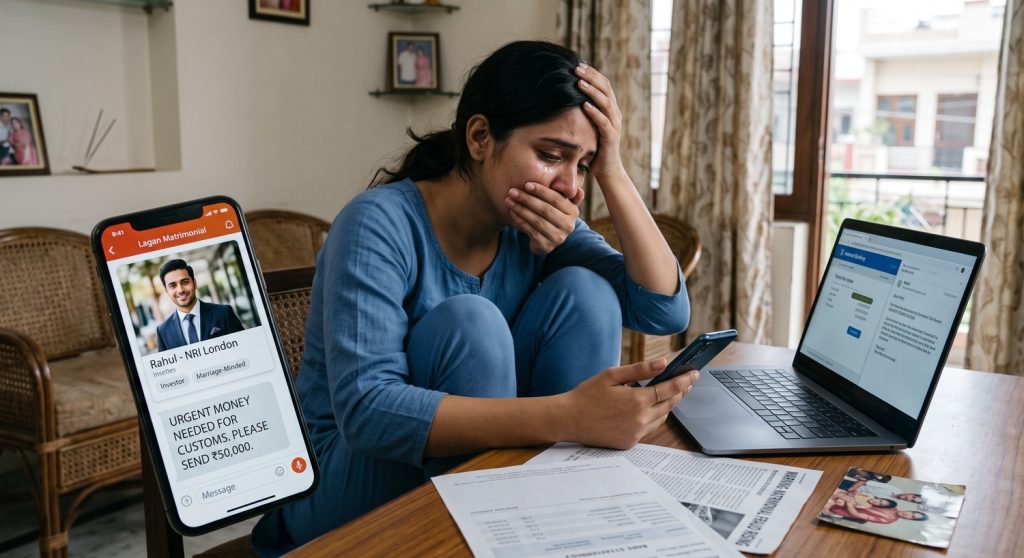
The government’s cyber crime nodal agency has flagged a sharp rise in online matrimonial fraud — fraudsters posing as wealthy professionals and NRIs to build trust before disappearing with the money. Here is what the advisory actually says, and what legal recourse looks like once the damage is done.
Marriage, for most people, is still built on trust extended before it is verified. That is exactly the gap the Indian Cyber Crime Coordination Centre (I4C), operating under the Ministry of Home Affairs, says fraudsters are now exploiting at scale. In a fresh advisory, the agency has warned that cybercriminals are using matrimonial websites and apps to pose as wealthy professionals or NRIs, build emotional trust through sustained conversation, and then extract large sums of money under the promise of marriage — a pattern the agency says is growing as digital matchmaking becomes the default way Indians look for a life partner.
Advisory at a Glance
| Issuing authority | Indian Cyber Crime Coordination Centre (I4C), Ministry of Home Affairs |
| Prepared by | National Cybercrime Threat Analytics Unit (NCTAU) |
| Platforms named | Shaadi.com, Jeevansathi.com, Matrimony.com, and dating apps including Tinder and Bumble |
| Typical impersonation | Wealthy businessmen, doctors, engineers, defence personnel, NRIs and MNC professionals |
| Victim profile | Often educated, financially stable individuals — not solely the digitally inexperienced |
| Core mechanism | Trust-building over weeks, followed by requests for gifts, customs charges, travel costs, or emergency funds |
The Playbook the I4C Has Identified
What makes this advisory notable is not that matrimonial fraud exists — it has for years — but that the agency has now documented a consistent, repeatable operating pattern behind it, suggesting organised rather than opportunistic activity.
Reported Modus Operandi
| Stage | What Happens |
|---|---|
| 1. Profile creation | A fake, polished profile is created using stolen or morphed photographs and fabricated professional details |
| 2. Credibility building | The fraudster claims to be a wealthy professional, defence officer, or NRI to establish quick trust |
| 3. Sustained contact | Regular calls, chats, and video interactions are used to build emotional closeness over time |
| 4. Marriage proposal | An early, often accelerated proposal of marriage is made to deepen the victim’s emotional investment |
| 5. Financial ask | Money is sought for gifts, customs duty on a parcel, travel expenses, or a sudden emergency |
| 6. Disappearance | Contact is cut once funds are received, or a fresh pretext is used to extract further payments |
This staged structure explains why matrimonial fraud is often harder for victims to report and prosecute than a straightforward phishing scam. The financial loss is entangled with a genuine emotional relationship, built over weeks or months, which delays recognition of the fraud and often makes victims reluctant to come forward at all.
Verify identity before trusting any matrimonial profile — never transfer money on the strength of an online acquaintance alone, however convincing the relationship feels.— MHA–I4C Advisory, July 2026
A Pattern Already Playing Out in Court
The advisory is not theoretical. Days before it was issued, a Maharashtra court dealt with a case that mirrors the exact playbook the I4C describes: a man from Nandurbar was booked for creating a fake matrimonial profile presenting himself as a wealthy hotelier and civil engineer, using the persona to establish a relationship with a divorced woman in Kalyan, and ultimately defrauding her of over ₹41 lakh after gaining her trust with promises of marriage. Cases like this illustrate why the I4C’s warning extends beyond simple money loss — the same trust-building mechanism used for financial fraud is frequently also a vector for coercion and abuse, compounding the harm well beyond the monetary figure.
The Legal Position for Victims
Cheating & Personation
A fabricated identity used to induce a financial transfer squarely attracts cheating provisions under the Bharatiya Nyaya Sanhita, with personation-specific provisions applying where a false identity — a fake name, profession, or NRI status — was central to the deception.
IT Act Provisions
Where the deception is executed through a computer resource or communication device — a fake profile, a WhatsApp chat, a video call — Section 66-D of the IT Act (cheating by personation using a computer resource) applies directly alongside the cheating charge.
Platform Accountability
Under the IT Rules, 2021, matrimonial platforms and dating apps are intermediaries obligated to act on verified abuse complaints and preserve registration data; failure to respond within a reasonable window can affect their safe-harbour protection under Section 79 of the IT Act.
Recovery Route
A complaint filed promptly through the National Cyber Crime Reporting Portal (cybercrime.gov.in) or the 1930 helpline can trigger a freeze request on the receiving bank account before funds are moved further down the chain — the single most time-sensitive step in any recovery effort.
Why Verification Alone Won’t Solve This
The I4C’s advisory places the burden of caution on the user — verify identity, avoid transfers, be wary of urgent requests. That guidance is sound, but it also exposes a structural gap the advisory itself does not resolve: most Indian matrimonial platforms still do not mandate government-ID verification before a profile goes live, and photo or document checks, where they exist, are inconsistently enforced. Until KYC becomes a baseline requirement for matrimonial and dating platforms operating in India, the practical burden of verification will keep falling on individual users — exactly the population the advisory acknowledges is not limited to the digitally naive, but increasingly includes educated, financially capable people who simply had no reliable way to check the story they were told.
Advisory — Protecting Yourself on Matrimonial & Dating Platforms
- 01Verify before you trust. Ask for a live video call early, run a reverse image search on profile photographs, and independently confirm claimed employment or professional credentials.
- 02Never transfer money. No genuine partner will ask for gifts, customs duty, travel costs, or emergency funds based solely on an online relationship — treat any such request as a decisive red flag.
- 03Be wary of moving off-platform too fast. A quick push to shift the conversation from the matrimonial site to WhatsApp or another app, before any real-world meeting, is a common step in the fraud sequence.
- 04Involve family or a trusted contact. Sharing details of a new online relationship with someone outside the conversation adds a layer of scrutiny the fraudster’s script is not built to survive.
- 05Report immediately. If money has already been transferred, call 1930 or file at cybercrime.gov.in without delay — and consult a lawyer early to pursue both the criminal complaint and any available civil recovery route.
If you or someone you know has been targeted through a matrimonial or dating platform, the window to freeze transferred funds and preserve digital evidence is short. Reach out for a confidential consultation on filing the right complaint and pursuing recovery.