

A Familiar Story With a New Twist
Online matrimony has become one of the most trusted ways for Indian families to find a life partner. But that trust is exactly what cybercriminals are exploiting — and a recent case out of Madhya Pradesh shows just how organised, and how local, this fraud economy has become.
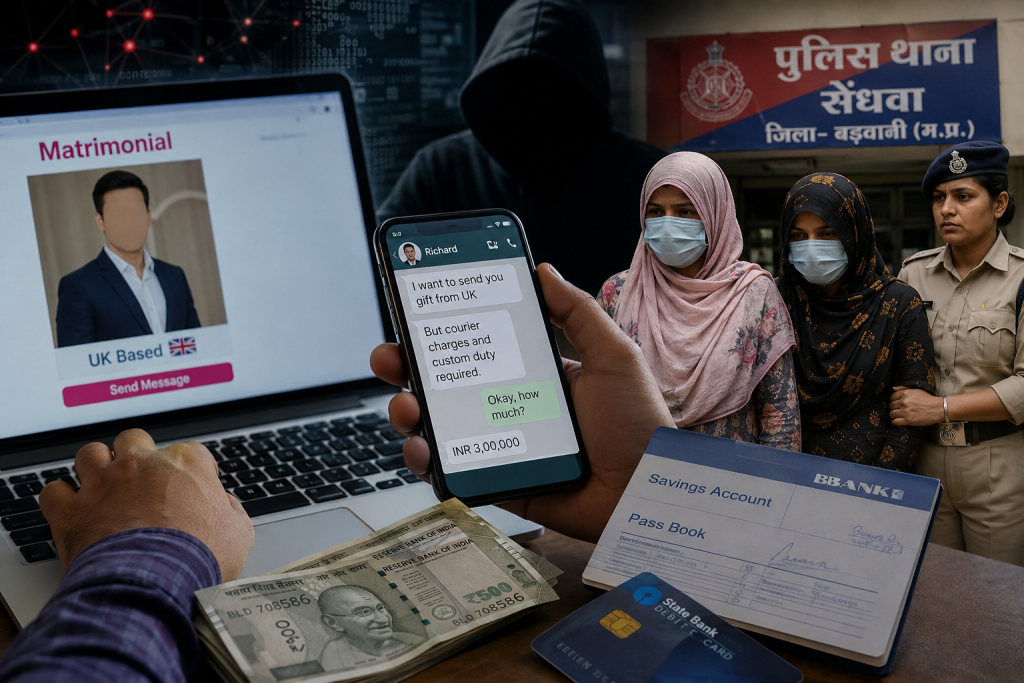
The Sendhwa City Police and Cyber Cell in Barwani district have arrested two women from Uttarakhand for their alleged role in a ₹3 lakh cyber fraud targeting a chartered accountant (CA), who was deceived through an online matrimonial platform. The case is a textbook example of “romance-cum-courier” fraud, but it also exposes a less-discussed layer of the crime: the ordinary people whose bank accounts are quietly rented out to launder the stolen money.
How the Scam Unfolded
According to police, the fraudsters built a fake profile posing as a prospective groom based in the UK. Using this persona, they contacted the victim on a matrimonial platform and worked to gain her trust — a process that in most such scams stretches over days or weeks of conversation, phone calls, and promises.
Once trust was established, the scammers introduced the hook that defines this type of fraud: expensive gifts. The “groom” allegedly claimed he wanted to send costly presents from abroad. Soon after, the victim began receiving demands for money — not for the gifts themselves, but for peripheral costs like courier charges and customs duty. It’s a classic escalation tactic: each payment feels small and “official” enough to justify, while the promised gift or relationship keeps the victim emotionally invested enough to keep paying.
By the time the deception unravelled, the CA had lost ₹3 lakh.
Tracing the Money: How Police Cracked the Case
Cybercrime investigations often hinge on following the money trail, and this case was no different. Investigators traced ₹95,000 of the defrauded amount to bank accounts belonging to two women — identified as Rekha and Nida, both residents of Bajpur in Uttarakhand’s Udham Singh Nagar district. Police have since seized this money.
What makes this case particularly instructive is what the two women reportedly told investigators during questioning. They claimed that a local man, identified as Shobhit Jatav, persuaded them to hand over access to their bank accounts. He allegedly told them the money being deposited was related to online gaming winnings, and offered them a commission of ₹5,000 per account in exchange for use of their banking credentials. Police say they are still verifying these claims as the investigation continues.
The “Money Mule” Problem Hiding Inside Cyber Fraud Cases
This detail is worth pausing on, because it’s becoming one of the most common — and most under-reported — features of cyber fraud investigations across India: the use of “money mules.”
Here’s how it typically works:
- The scammers rarely use their own bank accounts to receive stolen funds, since that would make them instantly traceable.
- Local recruiters approach people — often in smaller towns or economically vulnerable communities — offering easy money for simply lending their bank account or letting someone use their KYC details.
- The account holders, sometimes unaware of the full scale of the crime, receive a small commission while large sums of defrauded money pass through their accounts within hours before being withdrawn or transferred onward.
- When the case breaks, it’s often these low-level account holders — not the actual scam operators — who are the easiest for police to trace and arrest first.
This creates a difficult reality: the people caught first are frequently not the masterminds, but the most replaceable and most visible link in the chain. The alleged recruiter in this case, Shobhit Jatav, and the actual India- or UK-based operators (if the “groom” persona was run from abroad) represent the harder-to-reach parts of the network that investigations must now pursue.
Why Matrimonial Platforms Are a Favourite Hunting Ground
Fake “foreign groom” scams have become a recurring pattern in Indian cybercrime, and this case fits a well-documented mould seen in other states too — from fraudsters posing as UK-based suitors who dupe victims with fake jewellery and customs-detention stories, to networks that lure victims into fraudulent cryptocurrency investments after building trust through matrimonial chats. The playbook varies in its details, but the psychology is consistent.
Matrimonial platforms are attractive to fraudsters for a few clear reasons:
- Built-in trust: Users join with a serious, life-decision mindset, which makes them more emotionally receptive and less skeptical than they might be on a casual social platform.
- Cross-border credibility: An NRI or foreign-based profile carries social prestige in many Indian communities, making tall claims about wealth and gifts more believable.
- Slow-burn manipulation: Unlike a one-shot phishing scam, matrimonial fraud unfolds over time, allowing scammers to build a relationship before ever asking for money — by which point the victim has an emotional stake in believing the story.
- Layered demands: Asking for “courier charges” or “customs duty” feels more like paying a fee than sending money to a stranger, which lowers the victim’s guard.
Lessons for Users of Matrimonial and Dating Platforms
For individuals using these platforms, a few precautions can go a long way:
- Be wary of anyone who is quick to declare love or commitment and follows it up with plans to send expensive gifts.
- Never pay “customs,” “courier,” or “clearance” charges for a gift you didn’t ask for, especially to a personal bank account or via UPI to an unfamiliar name.
- Verify identity independently — a video call, a reverse image search of profile photos, or simply asking for details that can be cross-checked, can expose a fake profile.
- Treat urgency as a red flag. Scammers create time pressure (“the package is stuck at customs and will be returned/destroyed”) to prevent victims from thinking clearly or consulting family.
- Report early. The faster a fraud is reported to the Cyber Crime portal (cybercrime.gov.in) or the 1930 helpline, the higher the chance banks can freeze the funds before they’re withdrawn.
A Word of Caution for Bank Account Holders Too
The other half of this story is just as important: the temptation to earn quick commission money by “renting out” a bank account is itself a crime, regardless of whether the account holder fully understood what the money was for. Under Indian law, allowing your account to be used for laundering fraud proceeds can lead to serious criminal liability — including under provisions dealing with cheating and money laundering — even if you personally didn’t design the scam.
If someone offers payment in exchange for your bank details, ATM card, or OTP access, treat it as an immediate red flag. No legitimate “online gaming” or business arrangement requires access to your personal banking credentials.
The Bigger Picture
This ₹3 lakh case may seem modest compared to some of the multi-lakh and multi-crore matrimonial frauds reported elsewhere in India, but its real value lies in what it reveals about the machinery behind these scams: a front-facing “romance” narrative designed to extract money, supported by a hidden layer of recruited account holders who help move that money before it can be traced.
As investigations continue and police work to establish the roles of Rekha, Nida, and the alleged recruiter Shobhit Jatav, the case serves as a timely reminder — for matrimonial platform users and casual bank-account holders alike — that cyber fraud today is rarely the work of a lone scammer. It’s a network, and breaking it requires vigilance at every link in the chain.