

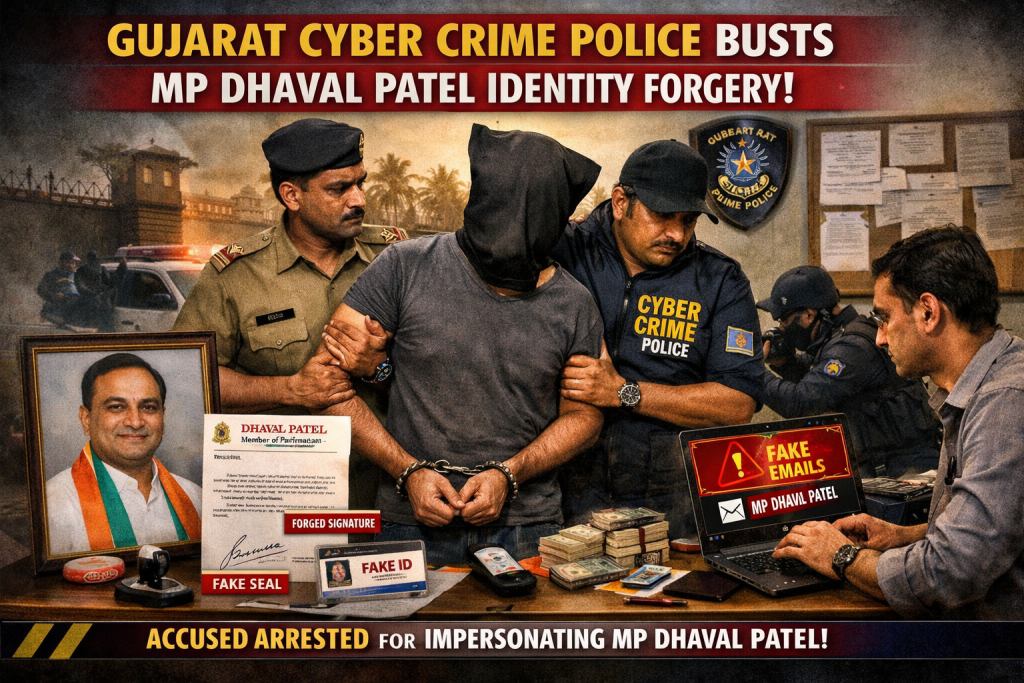
A 30-year-old accused allegedly built a business out of forged letterheads bearing the names of elected representatives and senior officials
Valsad, Gujarat — July 2026
Identity fraud has a new frontier, and it isn’t just bank accounts or Aadhaar numbers — it’s the credibility of elected office itself. Gujarat’s Valsad Cyber Crime Police have arrested a 30-year-old man from Ahmedabad on charges of fabricating official letterheads, forged signatures, and fake email accounts in the name of Valsad-Dang Lok Sabha MP Dhaval Patel, allegedly to mislead financial institutions and secure personal benefits.
How the Scheme Unravelled
According to police, the accused created a forged email ID and counterfeit official letterhead attributed to the MP and used them to send a recommendation letter to the Chairman of the State Bank of India. The same fabricated documentation was reportedly used to secure confirmed railway tickets under a special quota typically reserved for VIPs and officials — a benefit the accused had no legitimate claim to.
What makes the case notable is the speed of the response. Once a complaint was formally registered, the Valsad Cyber Crime Police tracked and arrested the accused in Ahmedabad’s Ishanpur area within hours — a signal of how quickly digital forensics and email-trail analysis can now compress an investigation timeline that once took weeks.
How the fraud allegedly worked:
- Created a forged email ID mimicking correspondence from MP Dhaval Patel’s office
- Fabricated an official-looking letterhead and forged signature to lend it authenticity
- Sent a fraudulent recommendation letter to the SBI Chairman seeking institutional favor
- Used similar forged documentation to obtain confirmed railway tickets under a special quota
- Reportedly repeated the pattern using the names of a former MP and government officials from West Bengal
Not a One-Time Impersonation
Investigators say the scheme wasn’t limited to a single elected representative. The accused is also alleged to have fabricated letterheads bearing the name of a former Member of Parliament as well as officials in West Bengal, using the same basic method to extract institutional favors — most notably confirmed rail travel under quotas meant for people with genuine official standing.
That pattern is what has led investigators to describe this as a more organized racket rather than an isolated act of opportunism: a repeatable template for impersonating authority figures, adapted to whichever name and letterhead would unlock the desired benefit at a given institution.
Why Impersonating an MP Works
Forged letterheads bearing a legislator’s name carry an unusual kind of institutional weight. Banks, railways, and government offices are conditioned to treat correspondence from an elected representative’s office with a certain deference — recommendation letters from MPs are a routine, legitimate part of how constituency services and institutional requests are often handled in India. That familiarity is precisely what makes the format exploitable: a forged letterhead doesn’t need to fool a document examiner, only a mid-level official processing a request who has no easy way to verify authenticity in real time.
This is a structural gap that isn’t unique to Gujarat. Similar cases elsewhere in the country — including fake government offices submitting forged signatures to claim development grants — point to a recurring vulnerability: institutions often lack a fast, reliable way to verify whether a letter genuinely originated from the office it claims to represent.
The Broader Enforcement Context
This arrest lands amid a period of heightened cyber-enforcement activity across Gujarat. The state’s cyber crime units have recently been running parallel operations against digitally enabled fraud of very different kinds — from large-scale “mule account” networks that route fraudulent transactions through recruited or duped bank account holders, to forgery rackets like this one that exploit the credibility of public office rather than banking infrastructure. Police in the state have registered well over a hundred FIRs and made hundreds of arrests this year as part of broader anti-fraud initiatives, suggesting cyber crime units are increasingly treating identity forgery and financial fraud as connected fronts of the same enforcement push.
What This Means Going Forward
A few takeaways stand out from this case:
- Institutional verification needs to modernize. Banks and public-facing institutions that accept correspondence from elected offices likely need faster, standardized ways to confirm authenticity — not just visual scrutiny of a signature or letterhead.
- Impersonation fraud isn’t confined to one victim category. The same accused allegedly reused the method across multiple names and even multiple states, suggesting the technique itself — not any specific target — was the real asset.
- Speed of response matters. An arrest within hours of a complaint shows how digital evidence trails (email metadata, IP logs, device forensics) can compress what used to be lengthy forgery investigations.
Forged signatures and official-looking letterheads remain a strikingly low-tech entry point into institutional trust — precisely because so much of that trust still depends on appearances rather than verification.
As the investigation continues, police are expected to examine the accused’s digital devices — reportedly seized at the time of arrest — for further evidence of how many institutions were targeted, and whether any of the earlier attempts succeeded in extracting money, favors, or benefits before this one was caught.