

What is the Online Gaming Authority of India (OGAI)?
The Online Gaming Authority of India (OGAI), established under the Ministry of Electronics and Information Technology (MeitY), is the central regulatory body overseeing all online games in India. It operates under the Promotion and Regulation of Online Gaming Act, 2025 and is responsible for determining and registering Online Social Games as well as E-Sports across the country.
Whether you are an Indian company, an individual developer, or a foreign entity looking to offer your game to Indian users — understanding OGAI’s registration process is essential before you launch.
Who Needs to Apply?
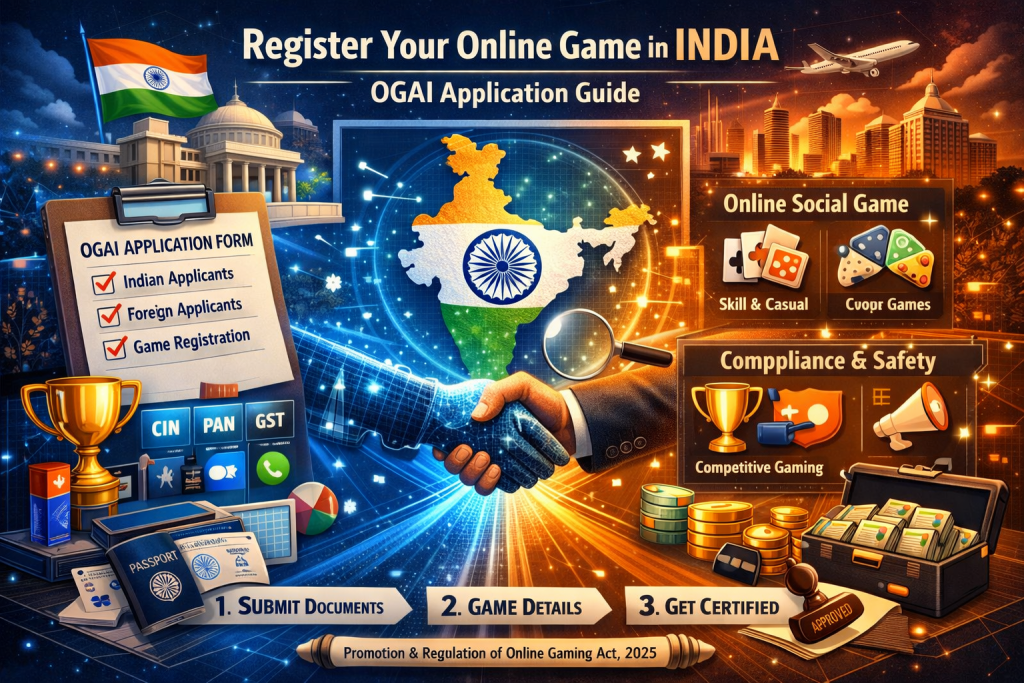
The OGAI Application Form is divided into three parts:
Part I — Indian User Registration (for applicants based in India)
Part II — Foreign User Registration (for foreign nationals or foreign entities)
Part III — Game Registration (mandatory for all applicants registering a game)
Important :- If your game falls under both the Online Social Game and E-Sport categories, you must submit separate applications for each. Similarly, Determination and Registration are two distinct processes and require separate applications.
Part I: Indian Applicants
Which Category Do You Fall Under?
Indian applicants must select one of six entity types and fill only the corresponding annexure:
| Entity Type | Key Documents Required |
| Company | CIN, PAN, GST, LEI (if applicable), D-U-N-S (if applicable) |
| LLP | Registration ID, PAN, GST |
| Partnership | PAN, Partner names, GST |
| Proprietorship | Identity Proof (Aadhar/Passport/Driving License), PAN, GST |
| Society | Registration ID, PAN, GST |
| Individual | Identity Proof, PAN, GST (if applicable) |
Address & Contact Details
All applicants must provide a complete address (building name, street, city, state, and PIN code) along with a designated Contact Person’s name, designation, email, and phone number — who may be the same as the applicant or a different individual.
Part II: Foreign Applicants
Foreign nationals and foreign companies can also apply under OGAI. There are two categories:
- Individual → Accepted identity documents include Passport, Driving License, National ID Card, or Residence Permit
- Company → Requires Company Registration ID, and optionally LEI number and D-U-N-S number
Part III: Game Registration — The Core of the Application
Step 1: Choose Your Service Type
Before filling in game details, applicants must select one of two service types:
Determination is required when:
- The Authority suo motu directs you to get your game determined, or
- You intend to offer your game as an E-Sport
Registration is required when:
- The Central Government issues a notification requiring it, or
- The game is intended to be offered as an E-Sport
You must also specify the reason for your application — whether it is a Request by Central Government, by the Authority, or Voluntary.
Step 2: Online Social Game or E-Sport?
You must choose one game type and fill the corresponding annexure.
Online Social Game categories include:
- Entertainment
- Recreational
- Educational
- Skill Based
- Others
E-Sport must meet ALL of the following criteria:
- Played as part of multi-sports events, OR involves organised competitive multiplayer events governed by predefined rules
- Outcome determined solely by skill — physical dexterity, mental agility, or strategic thinking
- May include registration/participation fees and performance-based prize money
- Must not involve any form of betting, wagering, or staking — by participants or anyone else
Game Details You Need to Provide
Game Genres (Select All That Apply)
OGAI’s form covers a comprehensive range of game genres:
| Genre Category | Sub-types |
| Action | FPS, TPS, Fighting Games, Beat ’em Ups, Platformers |
| Adventure | Story/Narrative, Point-and-Click, Survival/Crafting |
| RPG | MMORPG, Action RPG, Turn-Based RPG, Tactical RPG |
| Strategy | RTS, TBS, MOBA, Tower Defense, Auto-Battler |
| Simulation | Life, Business/City-Building, Vehicle, Sports, Farming |
| Sports & Racing | Traditional Sports (Cricket, Football), Racing, Extreme Sports |
| Casual & Social | Puzzle, Party Games, Trivia/Quiz, Board & Card Games |
| Horror & Thriller | Survival Horror, Psychological Horror |
| Sandbox/Open World | Building & Creation (Minecraft-style), Exploration |
| Hybrid & Emerging | Battle Royale, VR/AR Games, Roguelike, Idle Games, Educational Games |
Other Key Details
| Section | Options |
| Nature of Play | Single Player / Team/Cooperative / Peer-to-Peer Multiplayer |
| Intended Age Group | All Ages / 3+ / 7+ / 13+ / 18+ |
| Available Platforms | Web Browser, Mobile App, Console, Cloud Gaming, Other |
| Revenue Model | Free to Play / Pay-in Payout / Pay-in No Payout |
| In-App Purchases | Yes / No |
| Subscription Model | One Time / Monthly / Quarterly / Semi-Annually / Annually |
Note: If your game’s intended age group is below 18 years, enabling Parental Control is mandatory.
User Safety Features — Non-Negotiable
OGAI places strong emphasis on user safety. All applicants must declare whether the following features are implemented, and attach supporting documents for each:
- Age Verification System — Is user age verified before access?
- Anti-Addiction & Play Time Restrictions — Are there limits on playtime?
- Fair Play & Integrity Monitoring — Are cheating and fraud actively monitored?
- In-App Messaging — Is there a chat feature? If yes, is a Content Moderation Team in place?
- Parental Control — Can parents monitor and control their child’s gaming activity?
Grievance Redressal Mechanism
Every registered gaming platform must have a functioning Grievance Redressal System, including:
- An in-app grievance option (via Web Interface, In-App Section, or Other)
- A designated Grievance Officer with their name, designation, email ID, and phone number clearly listed
Legal Declaration & Penalties for Non-Compliance
In the final section, the authorised representative must declare:
- They are authorised to submit the application on behalf of the entity
- All information provided is true and accurate
- The entity will comply with the Online Gaming Act, 2025 and all applicable Indian laws
- They will promptly inform OGAI of any changes to a registered game
Consequences of Non-Compliance
Failure to comply with OGAI regulations can result in:
- Penalty of up to ₹10,00,000 (Ten Lakh Rupees)
- Suspension or cancellation of registration
- Prohibition from offering, facilitating, or promoting the game for a determined period
Certification Period
For Registration applications, applicants can choose a certification period ranging from 1 year to 10 years.
Quick Checklist Before You Submit
✅ Determine your applicant type — Indian or Foreign, Company or Individual
✅ Gather all required identity and business documents
✅ Decide your game type — Online Social Game or E-Sport
✅ Define your game’s genre, age group, platform, and revenue model
✅ Implement and document all required user safety features
✅ Appoint a Grievance Officer
✅ Prepare your Board Resolution or Authorization Letter
✅ Submit the completed form on the OGAI portal
Final Thoughts
The Promotion and Regulation of Online Gaming Act, 2025 marks a significant step in bringing structure, accountability, and user safety to India’s rapidly growing gaming industry. The OGAI registration framework ensures that both Indian and foreign game developers operate within a transparent and responsible ecosystem — with a strong focus on protecting users, especially children.
If you are a game developer, publisher, or gaming startup planning to operate in India, understanding and completing this process is not just a legal requirement — it is a foundation for building a trustworthy product in one of the world’s largest gaming markets.
This blog post is based on the official OGAI Application Form for Online Social Game / E-Sport Registration, issued under the Promotion and Regulation of Online Gaming Act, 2025. The original PDF form has been attached for reference.