

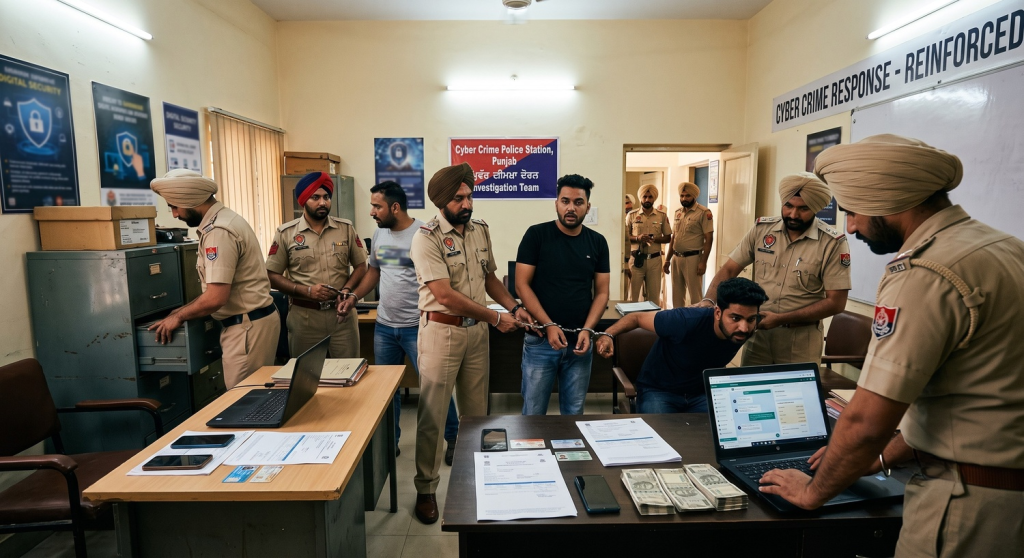
A year of dedicated cyber police stations in every district has changed how Punjab fights online fraud — the numbers show real gains, and real limits.
729 Arrests in one year
956 FIRs registered
29 Cyber crime stations
657 Awareness programmes The Headline Numbers
Punjab Police has completed two years of running dedicated Cyber Crime Police Stations in every district and police commissionerate in the state. Over the past year, that network has registered 956 FIRs across 29 stations and arrested 729 people in connection with cyber fraud cases. Director General of Police Gaurav Yadav framed this as the product of sustained investment by the State Cyber Crime Division over four years, combining enforcement with an extensive prevention push — nearly 657 citizen awareness programmes conducted across the state.
The arrests aren’t concentrated in one unit. The State Cyber Crime Division itself, headed by Special DGP V. Neeraja, registered 57 FIRs and arrested 56 people in high-profile, technically complex cases since May 2025. The remaining 673 arrests came from district-level Cyber Crime Police Stations working under Commissioners of Police and Senior Superintendents of Police — the everyday enforcement layer closer to individual victims. District-Level Breakdown
The distribution across districts gives a sense of where fraud activity — and enforcement capacity — is concentrated:
| Station | Arrests | Cases / FIRs |
|---|---|---|
| Ludhiana Commissionerate | 181 | 86 cases |
| Khanna CCPS | 74 | 31 FIRs |
| SAS Nagar CCPS | 57 | 52 cases |
| Kapurthala CCPS | 47 | 26 FIRs |
| Malerkotla CCPS | 32 | 41 cases |
| Patiala CCPS | ~40 | 74 FIRs |
| Pathankot CCPS | 23 | 44 cases |
Ludhiana’s numbers stand out disproportionately — 181 arrests against 86 cases suggests either larger organised networks being broken up per case, or a more aggressive investigative posture in that commissionerate compared to others working through a similar caseload with far fewer arrests.
What Kind of Networks Are Being Dismantled?
Beyond the topline arrest count, the specific operations disclosed by police show the texture of what’s actually being fought. In one operation targeting mule account infrastructure, the State Cyber Crime Division arrested three people for facilitating the opening and supply of bank accounts used in online financial fraud. The recovery list from that single raid is instructive: 23 ATM cards, two laptops, seven mobile phones, five SIM cards, forged bank and KYC documents including 14 cheque books and Udyam certificates, six rubber stamps, cryptocurrency worth 5,100 USDT, and roughly Rs 20 lakh sitting in bank accounts.
Separately, in Kapurthala, police uncovered a fraudulent call centre that targeted residents of the United States and Canada, inducing them to transfer money through Bitcoin and hawala channels — showing that Punjab’s cyber fraud problem isn’t purely domestic; it includes outbound-facing operations defrauding victims abroad, run from within the state.
Since May 2025, Cyber Crime Police Stations across Punjab have registered 9 FIRs and dismantled 5 separate mule account modules — evidence that enforcement is increasingly targeting the financial plumbing of fraud, not just individual scammers.
1
The Institutional Design That Made This Possible
The structural decision to place a Cyber Crime Police Station in every district and commissionerate — rather than centralising cyber investigation in one state-level unit — is itself a meaningful legal and administrative choice. It pushes jurisdiction and first-response capability down to the district level, shortening the time between a citizen’s complaint and an actual investigating officer with cyber-specific training taking it up, rather than routing it through a general police station unfamiliar with digital evidence handling.
2
Prevention Sits Alongside Enforcement, Not After It
The 657 citizen awareness programmes run in parallel with enforcement reflect a recognition that arrests alone don’t reduce victimisation — cyber fraud syndicates are quick to regenerate personnel even after a network is broken up. Awareness campaigns aimed at helping people recognise sextortion, fake online friendships, grooming, and gaming-related scams address the demand side of the problem, complementing the supply-side disruption that arrests represent.
3
Financial Recovery Is the Harder Metric to Move
Related figures from Punjab Police show the financial recovery side of this effort: over 63,749 bank accounts linked to cyber fraud were frozen in the past year, involving transactions worth approximately Rs 540.34 crore, with about Rs 64 crore recovered and refunded to victims since 2024. Notably, the share of fraud proceeds successfully frozen rose from 16.13 percent to 23.43 percent year-on-year — a meaningful improvement, but one that also quietly concedes that roughly three-quarters of the money moving through frozen fraud-linked accounts still isn’t being recovered before it disappears.Reading Between the Numbers: Strengths
- Decentralised jurisdiction works. Having a cyber station in every district appears to be translating into real caseload movement rather than becoming purely symbolic infrastructure — the FIR-to-arrest ratio (956 FIRs to 729 arrests) suggests investigations are actually converting into custody, not just paperwork.
- Targeting infrastructure, not just individuals. The mule-account module busts and the cross-border call centre discovery show enforcement moving beyond arresting whoever calls the victim, toward disrupting the account-supply and money-laundering layers that make fraud scalable.
- Rising fund-freeze rates. A jump from roughly 16 to over 23 percent of fraud proceeds frozen is a genuine operational improvement in the speed of financial tracking and inter-bank coordination.
Reading Between the Numbers: Open Questions
- Conviction data is notably absent. Arrests and FIRs measure police activity, not judicial outcomes. Without visibility into conviction rates from these 956 FIRs, it’s hard to assess whether this enforcement push is translating into successful prosecutions or getting bogged down at trial, as cyber fraud cases across India frequently do.
- Uneven district performance raises capacity questions. The wide gap between Ludhiana’s 181 arrests and other districts’ more modest numbers, despite comparable or larger caseloads elsewhere, suggests capacity and expertise may not be evenly distributed across Punjab’s 29 cyber stations — a gap that could leave some districts’ victims less well served than others’.
- Three-quarters of flagged funds remain unrecovered. Even with an improved freeze rate, the majority of money moving through fraud-linked accounts is still not being stopped before it’s laundered out — meaning enforcement is currently better at catching people than at catching money.
Closing Assessment
Punjab’s model — decentralised cyber stations, parallel awareness campaigns, and targeted mule-account operations — represents a genuinely more mature enforcement architecture than the complaint-portal-and-hope approach still common in many states. The 729 arrests and rising fund-freeze rate are real, measurable gains. But the honest reading of this data is that Punjab has built strong capacity to catch and arrest people after fraud occurs, while the harder, less glamorous work — actually recovering the bulk of stolen money, and securing convictions that create lasting deterrence — remains a work in progress rather than a solved problem.