

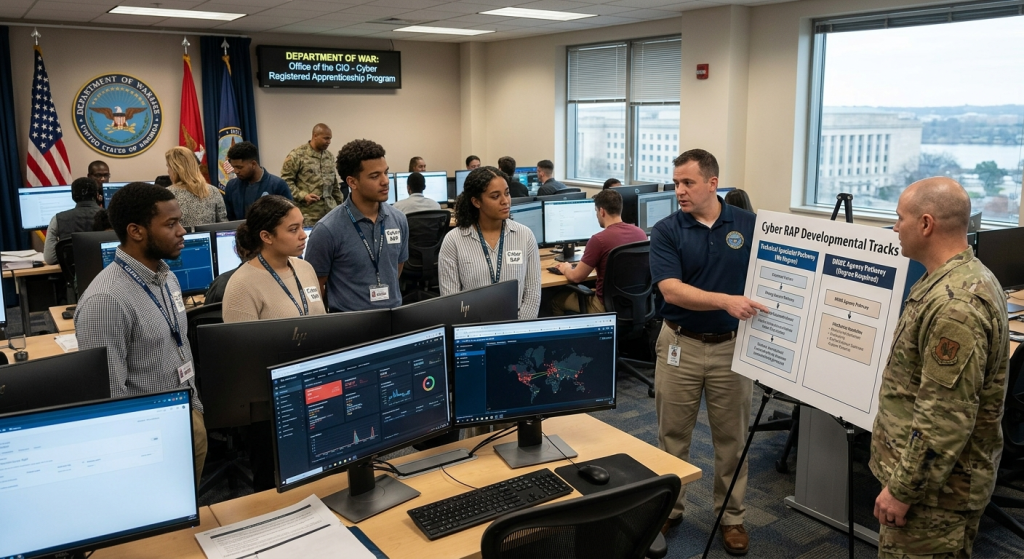
No degree required, a modest government salary, and 70,000 inquiries before the application window even opened. The Defense Department’s new apprenticeship pilot is a workforce experiment worth watching — including for what it reveals about a cybersecurity staffing shortage that isn’t unique to the United States.
Agovernment job posting rarely generates enough traffic to crash its own application portal. The Pentagon’s new Cyber Registered Apprenticeship Program — Cyber RAP, as it is being called internally — did exactly that. Aimed at people with no cyber degree, no prior professional experience, and often no formal credential at all, the program opened its application window this week with more than 70,000 prior inquiries already on record. For a country whose cybersecurity sector alone carries over half a million unfilled vacancies, that response is itself the story — and it says as much about the state of the global cyber labour market as it does about the Pentagon’s own staffing needs.
Program at a Glance
| Formal name | Cyber Registered Apprenticeship Program (Cyber RAP) |
| Administered by | Department of War (DoW) Office of the Chief Information Officer |
| Application window | Opened 7 July 2026; closes 11:59 p.m. ET on 17 July 2026 |
| Duration | 12 months, full-time, paid |
| Annual salary | US $22,584 (GG-7 through GG-9 posting on USAJOBS) |
| Eligibility | Over 18, U.S. citizen, able to obtain and maintain a government security clearance — no degree required for the core track |
| Prior interest | More than 70,000 inquiries recorded since the program was first announced in late April 2026 |
Two Pathways, Two Very Different Requirements
What makes Cyber RAP structurally interesting is that it is not one apprenticeship but two, deliberately built with different entry standards to serve different parts of the Department’s workforce needs.
Developmental Tracks
| Track | Requirement | Focus |
|---|---|---|
| Technical Specialist Pathway | No college degree required | Rapid, hands-on skill acquisition for general DoW civilian cyber roles |
| DMDC Agency Pathway | Accredited degree required | Specialised placement within the Defense Manpower Data Center, per agency qualification standards |
Apprentices train across security operations, network defence, ethical hacking, and the use of artificial intelligence in cyber threat analysis, combining online coursework with hands-on labs and on-the-job mentorship under DoW cyber personnel. Successful completers gain industry-recognised certifications and, notably, the option to convert non-competitively into a permanent DoD cyber position — including roles like Cyber Defense Analyst and Incident Responder that sit directly on the front line of defending defense networks and the broader Defense Industrial Base.
Seventy thousand inquiries compressed into an eleven-day application window tell you the talent pool was always there. People will show up when someone gives them a clear path in.— Jacob Krell, Senior Director for Secure AI Solutions and Cybersecurity, Suzu Labs
The Clause Worth Reading Twice
Buried in the programme’s terms is a detail that deserves more attention than it has received: participants who fail to complete the apprenticeship are required to repay the government for the training they received, unless granted a waiver for specific circumstances such as illness or severe financial hardship. The programme’s own materials do not disclose how much a dropout would actually owe. For a workforce entry point explicitly designed to attract people without existing financial cushion — no degree, no professional cyber background, a modest training-year salary — a repayment obligation of undisclosed size is a meaningful piece of fine print. Any applicant should treat this the way they would treat a loan covenant: understand the total exposure, the waiver criteria, and the process for invoking a waiver, before signing on, not after circumstances change.
Why a U.S. Defense Programme Is Relevant Globally
The Clearance Catch-22
Analysts note the programme solves a structural bottleneck common to defense and government cyber hiring everywhere: candidates cannot get a cleared role without a clearance, and cannot get a clearance without a sponsoring role. A registered apprenticeship that sponsors the clearance from day one is a transferable model for any government building a domestic cyber workforce.
Skills-Based Hiring, Formalised
Cyber RAP is part of a broader U.S. federal shift — reflected in updated Office of Personnel Management technology hiring standards — toward removing degree requirements in favour of demonstrated aptitude. This mirrors a debate already underway in India’s own IT and cyber sectors around certification-based hiring versus formal degree gatekeeping.
A Workforce Gap With No Borders
The U.S. cites more than 500,000 unfilled cybersecurity vacancies across public and private sectors combined. India’s own cybersecurity workforce shortfall is frequently cited in similar terms by industry bodies — the shape of the problem, and increasingly the shape of proposed solutions, is converging across jurisdictions.
Pay Versus Retention Risk
Analysts have flagged that the Pentagon’s entry-level salary may struggle to compete with private-sector offers once apprentices are certified and cleared — a retention risk relevant to any public cyber workforce programme that trains talent the private market will then bid for.
A Model, Not a Blueprint
It would be a mistake to read Cyber RAP as a template that transplants cleanly elsewhere. It rests on features specific to the U.S. system — a federal security clearance regime, the USAJOBS hiring infrastructure, and a defense budget capable of absorbing a large apprentice cohort even at modest individual salaries. What does travel well is the underlying insight the programme’s early numbers validate: when a government removes formal credentialing barriers and offers a structured, paid, mentored pathway into cyber roles, the response from an underserved talent pool can be immediate and large. For any jurisdiction — India included — weighing how to close a cybersecurity staffing gap that is now a matter of national digital resilience rather than simply an HR problem, that is the more durable lesson than any specific programme design.
Advisory — For Prospective Applicants and Programme Designers Alike
- 01Read the repayment clause in full before applying. Request written clarification on the maximum repayment exposure and the documented waiver process — do not rely on verbal assurances at the application stage.
- 02Understand the clearance implications. A sponsored security clearance is a significant asset, but it also comes with post-employment restrictions and disclosure obligations that extend beyond the apprenticeship itself.
- 03Factor in relocation and cost of living. Most positions are based in the Washington, D.C. area, including Fort Meade and Alexandria, and relocation costs are the applicant’s own responsibility.
- 04For policymakers evaluating similar models: pair any skills-based entry pathway with a clear, capped, and publicly disclosed financial obligation structure — undisclosed repayment terms undermine the accessibility the programme is designed to offer.
If you are evaluating a cyber workforce programme, an apprenticeship agreement, or a government training bond with financial repayment terms, understanding your actual exposure before signing is essential. Reach out for a review of any apprenticeship, bond, or training agreement you are considering.