

Published July 1, 2026 · 6 min read · Odisha / Maharashtra
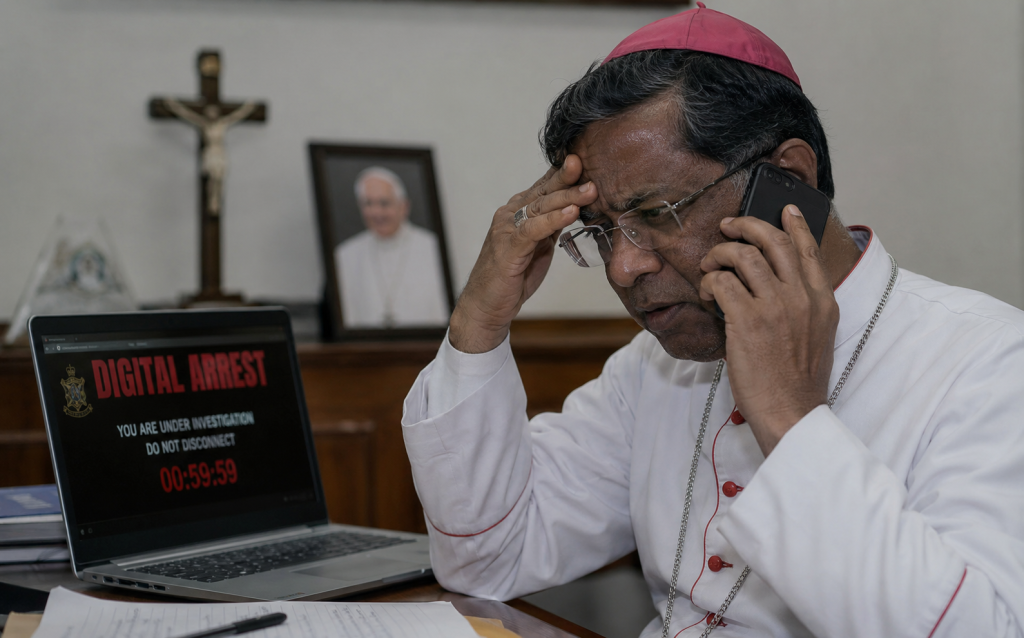
A Catholic bishop, a fabricated police case, and a fourteen-lakh-rupee transfer — the Rourkela digital arrest scam is a reminder that even well-educated, publicly respected individuals aren’t immune to one of India’s fastest-growing fraud tactics. Here’s what happened, how the scam actually works, and why it keeps succeeding.
₹14.36LAmount lost
2Accused arrested
MumbaiOrigin of accused
March 10 Complaint filed
What Happened
Bishop Kishore Kujur of the Catholic Diocese of Rourkela was defrauded of ₹14.36 lakh in a “digital arrest” scam. Police have since arrested two men from Mumbai in connection with the case: Nayan Lalit Nathwani (47) of Charkop and Dhabal Paresh Pandya (35) of Kandivali. The arrests followed a complaint the Bishop filed on March 10, after which investigators tracked the money trail and the individuals allegedly involved back to Mumbai.
Announcing the arrests to the media on Tuesday, DIG (Western Range) Brijesh Kumar Rai and Rourkela SP Nitesh Wadhwani laid out the details of the case, underscoring that even prominent, publicly known individuals are being actively targeted by organized cyber fraud networks operating out of major cities like Mumbai.
What Is a “Digital Arrest” Scam?
“Digital arrest” is one of the more psychologically aggressive scams currently active in India. Unlike scams that rely on greed or the promise of easy money, this one relies almost entirely on fear. Fraudsters impersonate law enforcement or investigative agencies — often posing as police, customs officials, or CBI/ED officers — and convince the victim that they are personally implicated in a serious crime, such as money laundering, drug trafficking, or a parcel containing illegal items sent in their name.
How the Scam Typically Unfolds
- Initial contact: The victim receives a call or video call from someone posing as a police officer or government official, often using official-looking uniforms, backdrops, or fake ID cards visible on screen.
- The accusation: The victim is told they are linked to a serious crime — frequently something involving a courier parcel, a bank account used in fraud, or a case under investigation by a central agency.
- Isolation and pressure: The victim is instructed to stay on the call continuously — sometimes for hours — and told not to inform family, friends, or lawyers, under the pretext that the “investigation” is confidential.
- The fake “arrest”: Victims are told they are under “digital arrest” and must remain visible on camera, unable to leave, while the fraudsters build urgency and fear of imminent physical arrest.
- The payment demand: To “prove innocence” or avoid arrest, the victim is pressured into transferring money — often framed as a refundable “verification” amount — to accounts controlled by the fraudsters.
There is no such thing as a “digital arrest” under Indian law — no agency can arrest, detain, or hold someone in custody over a video call. The entire premise of the scam is legally fictitious.
Why This Case Matters
This case is notable for a few reasons. First, the victim’s profile: a religious leader with a public role and presumably a well-established reputation to protect. Digital arrest scams frequently succeed against exactly this kind of victim, since the fear of public association with a crime — even a false one — can be more motivating than the fear of financial loss itself.
Second, the geography of the case is telling. The scam targeted a victim in Rourkela, Odisha, but the accused were traced to Mumbai — a reminder that these networks routinely operate across state lines, with victims and perpetrators often separated by thousands of kilometers. This cross-state structure is precisely what makes digital arrest scams hard to trace quickly; it took from March 10 until the arrests were announced for police to build the case and locate the accused.
Third, the successful arrest and public disclosure of the accused’s identities serves an important secondary purpose beyond justice for this one case — it signals to the public, in concrete terms, that these scams are traceable and that police are actively pursuing perpetrators, which may help counter the sense of helplessness that makes victims comply in the first place.
The bigger pattern: Digital arrest scams have consistently produced some of the largest single-victim losses in India’s cybercrime landscape, precisely because the psychological pressure is sustained over hours, not minutes — giving fraudsters far more room to escalate the amount demanded than a single phishing message or fake link ever could.
How to Protect Yourself From Digital Arrest Scams
- Remember: no Indian law enforcement or government agency conducts arrests, investigations, or “verifications” over a video call. This concept does not exist in law.
- If you receive such a call, do not panic, and do not stay on the line under pressure. Hang up and independently verify by contacting the relevant department through its official number.
- Never transfer money to “prove innocence” or avoid arrest — no legitimate agency will ever ask for payment this way.
- Inform a family member or trusted person immediately, even if the caller insists on secrecy — genuine investigations do not require isolation from your support network.
- Report the incident immediately to the national Cyber Crime helpline (1930) or via cybercrime.gov.in, and preserve call recordings or screenshots as evidence.
Based on public statements from DIG (Western Range) Brijesh Kumar Rai and Rourkela SP Nitesh Wadhwani. This report is for informational purposes; details may be updated as the investigation progresses.