

What Happened
Gurugram police have arrested six people accused of running a bank-account supply operation for a Dubai-based cyber fraud syndicate. The gang is linked to an investment scam worth more than Rs 2.65 crore. According to police, the accused didn’t just hand over personal bank accounts — they allegedly set up fake firms specifically to open business accounts, which were then passed on to handlers based overseas.
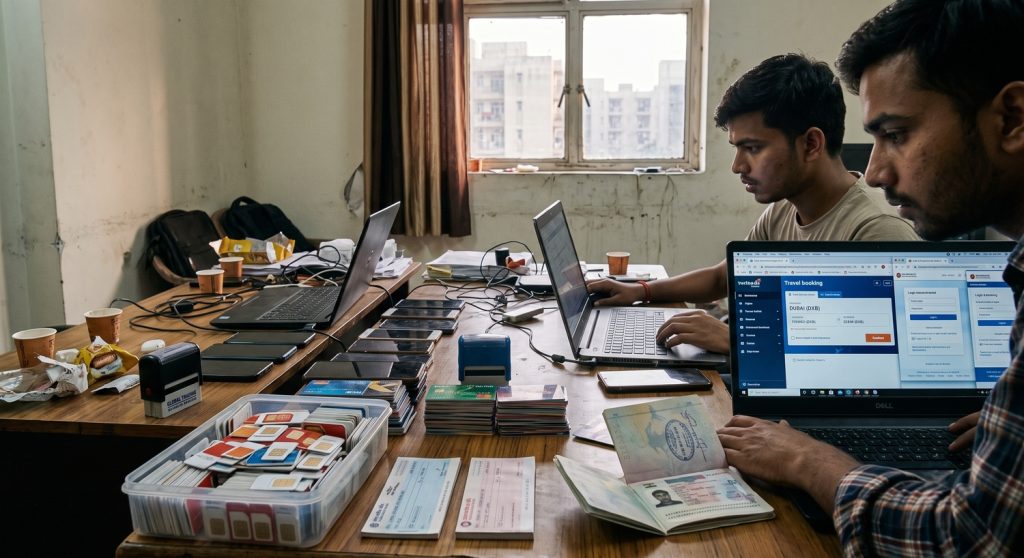
The recovery list from the arrests paints a clear picture of a small-scale banking factory: three laptops, 16 mobile phones, 90 ATM cards, 42 cheque books, 35 SIM cards, rubber stamps for four different firms, and — notably — a passport bearing a Dubai visa, suggesting at least one member of the group had direct contact with handlers abroad.
Why “Fake Firms” Change the Scale of the Problem
Most mule-account cases involve individuals renting out their own personal savings accounts for a one-time commission. This case is a step up in sophistication: the accused allegedly incorporated or registered fake firms purely as a vehicle to open current accounts, which banks generally issue with fewer restrictions and higher transaction limits than personal savings accounts.
This detail matters because it mirrors a pattern investigators have flagged repeatedly in recent Dubai-linked fraud cases. In one recent Delhi Police case involving a similar network, accused individuals allegedly created shell firms and opened current accounts under company names to layer and launder proceeds of investment frauds, with entire “banking kits” — <cite index=”34-1″>ATM cards, cheque books, SIM cards linked to the accounts, and net-banking credentials</cite> — handed over to handlers as a package. The Gurugram case, with its 90 ATM cards and 42 cheque books for what appears to be a handful of firms, fits this template closely: it’s not about one account being misused, it’s about building a small, reusable banking infrastructure designed to be leased out.
Firms also offer another advantage to fraud networks: a company name and a business bank account look more legitimate to a bank’s automated fraud-monitoring systems, and to victims themselves, than a personal account receiving oddly large lump-sum transfers.
The Dubai Connection
References to Dubai-based handlers have become a recurring feature of major Indian cyber fraud investigations over the past year, and this case fits an emerging pattern rather than being an isolated one. Just weeks ago, the Enforcement Directorate uncovered a transnational syndicate that <cite index=”30-1″>targeted Indian victims with fake job, investment, and gaming scams, funnelling illicit funds through a web of 216 mule bank accounts, shell companies, and overseas fintech platforms</cite>, with the crypto trail eventually traced to Dubai. That investigation alone identified <cite index=”30-2″>216 mule bank accounts through which approximately ₹303.24 crore in proceeds of crime were laundered</cite>, and found the network continuing to operate even after enforcement action had begun.
Dubai’s appeal to these syndicates isn’t a coincidence. It offers proximity to India, a large Indian expatriate community that can provide cover, relatively fast international money transfer and crypto off-ramp options, and a jurisdiction where coordinating an extradition or an evidence-sharing request takes considerably longer than a domestic arrest. For the syndicate, Indian mule-account suppliers are simply the last mile — the disposable, replaceable layer that takes the legal risk while the organizers stay outside the reach of Indian courts.
A Familiar Playbook, Repeated Across Gurugram
This isn’t the first time Gurugram’s cyber police have dismantled a bank-account supply chain feeding an investment scam. Past cases from the same police jurisdiction show a strikingly consistent method:
- A fraud is reported after a victim is lured into a fake stock-market or investment scheme and loses a large sum.
- Police trace the money to an account opened under a real person’s name or a shell firm.
- The account holder is found to have handed over the account — sometimes including a bank employee complicit in opening it — in exchange for a one-time payment, often just a few thousand rupees.
- Further arrests reveal that the same handlers had recruited multiple account suppliers, sometimes including people working inside banks themselves.
Earlier Gurugram cases have included a serving bank employee who provided accounts to fraudsters, and even a bank deputy manager arrested alongside an account holder for helping open an account for cyber criminals. This recurring involvement of banking insiders — whether relationship managers, assistant managers, or business correspondents — is one of the more troubling threads running through these investigations, since it suggests that fraud networks are actively cultivating contacts inside the formal banking system, not just approaching random members of the public.
Why the Recovered Items Matter
The specific haul from this arrest — 90 ATM cards and 42 cheque books, well beyond what six individuals would need for personal use — is itself evidence of an operation built for scale rather than a one-off. Multiplying accounts across several fake firms allows a syndicate to:
- Spread incoming victim payments across many accounts so no single account trips a bank’s suspicious-activity threshold.
- Keep operating even after one or two accounts get frozen, since replacements are already in hand.
- Make the money trail harder to follow, since investigators must link multiple firms, multiple accounts, and multiple SIM cards back to the same handlers.
The stamps for four separate firms suggest the syndicate treated fake companies almost as disposable shells — created, used briefly to open accounts, and then discarded once the account had served its purpose or been flagged.
What This Means for Ordinary Bank Customers and Small Business Owners
Cases like this are also a reminder for the wider public, not just for potential mule-account recruits. Fraud networks increasingly need genuine-seeming documentation — identity proofs, address records, GST registrations — to set up their fake firms and open accounts without raising suspicion. This has made identity theft and forged business registrations a growing feeder crime for cyber fraud, meaning individuals should be cautious about:
- Sharing signed KYC documents, PAN cards, or Aadhaar copies with unfamiliar parties, even for seemingly minor paperwork.
- Registering a business address or using their identity to help a friend or relative “set up a company quickly” without knowing exactly what the company will be used for.
- Ignoring unexpected bank account or GST notifications, which can be an early sign that their identity has been used to open an account without their full knowledge.
The Bigger Picture
The involvement of a Dubai-based handler, fake firms, and a small industrial-scale stockpile of banking materials shows how far mule-account operations have evolved from the earlier pattern of individuals simply lending out their own savings accounts for quick cash. What Gurugram police uncovered here looks less like a handful of opportunistic individuals and more like a small, purpose-built unit acting as a regional supply node for an international fraud network — one piece in a much larger machine that stretches from victims in India to handlers and crypto off-ramps abroad.
As with earlier mule-account busts, the six people arrested are likely to be the most visible and most reachable part of the chain. The harder task — and the one Indian investigators increasingly say is essential to actually shutting these networks down — is following the passport, the crypto wallets, and the Dubai contacts far enough to reach the people actually directing the fraud.