

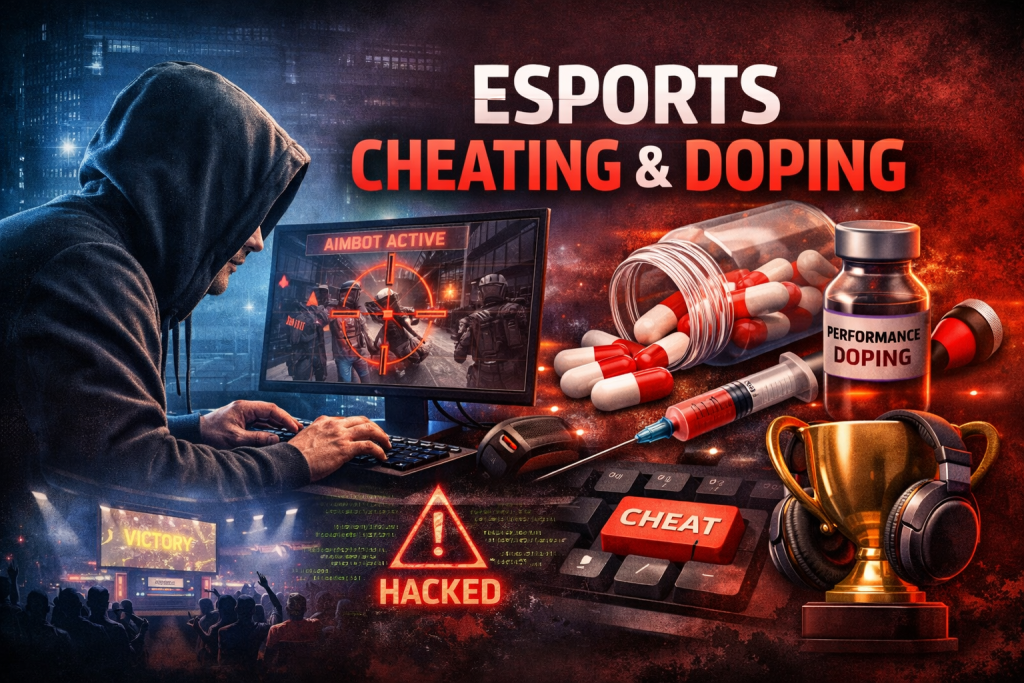
Esports has grown into a genuine global spectacle — tournaments with prize pools north of $40 million, broadcasts watched by hundreds of millions of fans, and players treated like national heroes. But wherever there’s serious money and global fame, there’s also a serious temptation to cheat. Unlike traditional sports, esports’ “field of play” is software, which means it can be hacked, modified, or exploited from anywhere in the world. Add a patchwork of rules that differ by publisher, league, and country — and no single global governing body like FIFA to unify them — and you get an industry that’s been forced to learn integrity enforcement the hard way, scandal by scandal.
Why Esports Is So Easy to Cheat
Four forces make competitive gaming uniquely vulnerable. The prize money has become large enough that even a small unfair edge can translate into a life-changing payday. There’s no single authority setting and enforcing universal rules — every publisher, league, and country runs its own playbook. The competition itself happens inside code, which is inherently hackable and remotely exploitable in a way a physical playing field never could be. And because cheats can be as subtle as a hidden phone, a shared screen, or a quietly modified driver, they’re often very difficult to catch on review, even by trained officials.
Software Cheats and Live Hacking
The most familiar form of esports cheating is the software exploit. Aimbots and triggerbots automatically aim or fire the moment an enemy appears, stripping out human reaction time entirely. Wallhacks and ESP (“extra sensory perception”) tools reveal enemy positions, health, and items straight through walls. Some cheats are less about software injected into the player’s own machine and more about exploiting flaws in the broadcast itself — as in the well-known 2020 CS:GO coaching scandal, where a spectator camera bug let coaches scout live enemy positions during matches. In one such case, 37 coaches, including staff from major organizations like Mousesports and MIBR, were sanctioned by the Esports Integrity Commission (ESIC), with bans ranging from a few months to several years.
Hacking has also moved beyond individual cheating into outright sabotage. In 2026, a hacker using the handle “Destroyer2009” remotely injected aimbot and wallhack cheats directly into professional players’ games mid-broadcast — turning what should have been a fair match into a live demonstration of how exposed competitive anti-cheat systems still are. Older cases show how far players themselves will go to hide evidence: in 2018, an OpTic India player known as “forsaken” was caught with an active cheat tool during a tournament and tried to delete it on the spot, only for officials to recover the file and hand down a five-year competition ban.
Ringers, Stand-Ins, and Identity Fraud
A quieter but equally serious form of cheating involves substituting a more skilled player for the one who’s actually registered to compete — a practice known as using a “ringer.” The clearest recent example comes from the SEA Games, where Thai Arena of Valor player Naphat “Tokyogurl” Warasin was caught with active screen-sharing software running on a hidden phone during her match. Her boyfriend and fellow professional player, Kong “Cheerio” Sutprom, was secretly controlling the match remotely on her behalf. The fallout was severe: Thailand’s women’s team was forced to withdraw from the competition, Naphat received a lifetime ban, and in March 2026 a Bangkok court went further still, convicting both players under the country’s computer-crime law and sentencing them to three months in detention. The presiding court didn’t mince words, framing the offense as having jeopardized the credibility of the nation itself.
This case illustrates a broader shift worth noting for anyone tracking esports law: ringer fraud isn’t just a competitive rules violation anymore. When it involves identity deception and unauthorized remote access, it can constitute computer fraud under ordinary criminal statutes — exposing offenders to real prison time, not just a tournament ban.
Match-Fixing and Betting Fraud
If ringers are about who’s actually playing, match-fixing is about whether the outcome was ever real in the first place. The most consequential case here remains South Korea’s 2015 StarCraft II scandal, involving Lee “Life” Seung-Hyun — once the youngest-ever GSL champion — who was caught taking payments to deliberately lose matches on cue. A broker named Sung Jun Mo paid Life to throw games and then profited by betting on the predetermined outcomes through illegal gambling sites. Unlike most cheating cases, which end in bans, this one triggered a full criminal prosecution: an 18-month prison sentence, a fine equivalent to roughly $64,000, a three-year competitive ban layered on top of the prison term, and a lifetime ban from every KeSPA-affiliated tournament. It remains one of the clearest examples of esports fraud being treated by a court exactly like traditional sports betting corruption.
Doping: The Adderall Admission That Changed Everything
Esports doping doesn’t look like anabolic steroids — it looks like prescription stimulants used to sharpen focus and reaction speed during hours of high-intensity play. The watershed moment came at ESL One Katowice 2015, a $250,000 Counter-Strike: Global Offensive tournament, when Cloud9 player Kory “Semphis” Friesen publicly admitted that his entire team had used Adderall during competition, casually noting it had been pretty obvious to everyone involved. The admission blew open a practice that had quietly spread across competitive gaming without ever being tested for or formally policed.
The reasoning for why stimulants matter in esports is straightforward: the sport demands split-second reflexes and sustained mental focus over many hours — precisely what stimulant drugs are designed to enhance. At the time of Friesen’s admission, not a single tournament had any drug-testing policy in place. Cloud9 publicly distanced itself from the comments, and Friesen left the team only weeks later.
To its credit, the industry responded quickly. Within two weeks of the admission, ESL banned drugs, alcohol, and performance-enhancing substances from competition entirely, backing the rule with the threat of exclusion. ESL went on to partner with the World Anti-Doping Agency and Germany’s national anti-doping agency to design legitimate testing standards, and random skin and saliva testing began at ESL One Cologne later that year before expanding across every Intel Extreme Masters event. Today, that oversight function has been absorbed into the broader mandate of the Esports Integrity Commission, which monitors doping alongside hacking and match-fixing across the industry.
Private Rulebooks vs. Public Law
Here’s the part that matters most for anyone thinking about esports legally: most of what governs competitive gaming today isn’t law at all — it’s private contract. Tournament rules, publisher terms of service, and ESIC sanctions are enforced by leagues like ESL and publishers like Valve and Riot Games, and the penalties they hand out are bans, fines, prize forfeiture, and disqualification. Players accept these terms with a single click, not through any public legislative process, which means enforcement is fast but limited strictly to the game or league in question.
Public law works very differently. It only enters the picture when cheating crosses into fraud, unauthorized computer access, or illegal gambling — but when it does, the penalties become genuinely severe: prison time, criminal fines, and asset forfeiture. Thailand’s Computer Crime Act and South Korea’s Game Industry Promotion Act (GIPA) are the clearest examples of countries that have chosen to treat serious esports misconduct as a criminal matter rather than leaving it purely to private governance. It’s slower and bound by jurisdiction, but it carries a deterrent weight that a tournament ban simply cannot match.
A quick snapshot of how different jurisdictions currently police esports crime:
| Country / Body | Key Law or Authority | Maximum Penalty |
| South Korea | Game Industry Promotion Act (GIPA) | 2 years prison + ₩20M fine |
| Thailand | Computer Crime Act | 3 months to several years detention |
| Germany | eSport-Bund Deutschland (ESBD) Code | €10,000 fine + expulsion |
| European Union | Digital Services Act, Art. 21 | Right to appeal bans via dispute body |
| Global (private) | Esports Integrity Commission (ESIC) | Bans up to lifetime, cross-league |
How a Cheating Case Actually Unfolds
Most esports integrity cases follow a fairly consistent arc. It starts with detection — anti-cheat software, referees, or rival teams flagging suspicious behavior mid-match. From there, league integrity bodies like ESIC or the publisher itself investigate footage, server logs, and hardware. If the evidence holds up, a competitive sanction follows: disqualification, prize forfeiture, and bans ranging from a few months to a lifetime. Where the conduct also breaks fraud, hacking, or gambling laws, the case can be referred to police and the courts — and from there, sentencing can mean fines, a criminal record, or imprisonment, exactly as it played out in Thailand and South Korea.
Why This All Matters Going Forward
As prize pools and sponsorship deals keep climbing, the incentive to cheat climbs right alongside them — meaning integrity enforcement has to scale at the same pace as the money, not lag behind it. Private oversight from ESIC and publisher anti-cheat teams can move fast, but it stops at the edge of their own platforms and leagues; it has no power once an offender steps outside that ecosystem. That’s exactly why criminal prosecutions in places like Thailand and South Korea matter so much — they signal that esports fraud now carries real-world legal consequences, not just a forum ban and a bruised reputation. With over 640 million fans tuning in globally, the entire foundation of the industry’s next decade rests on one simple thing: the conviction that what they’re watching is actually fair.
This post is for general informational purposes and reflects publicly reported facts and figures as summarized in the source material. It is not legal advice.